


Why AI-powered cyber attacks are outpacing human defenders
Artificial intelligence is changing the speed and scale of modern cyber threats, making AI-powered cyber attacks a growing concern for organisations across Australia.
Over the last four decades, organisations have adapted to several major technology shifts. The rise of the internet, mobile devices, cloud computing, software-defined infrastructure and remote work have all changed how businesses operate and how technology environments are designed, managed and secured. Each of these developments delivered clear operational and commercial benefits, but they also introduced new dependencies, new risks and new opportunities for attackers.
Artificial intelligence is creating a similar transition. Most organisations are currently focused on the productivity benefits that AI can deliver, whether that involves analysing information more quickly, automating repetitive tasks or helping employees make better use of their time. At the same time, attackers are applying many of the same capabilities to activities such as reconnaissance, phishing, vulnerability research and social engineering.
Recent guidance published by the Australian Signals Directorate (ASD) highlights this dual reality. AI has the potential to support defenders by improving threat detection, accelerating investigation processes and reducing the manual effort associated with routine security tasks. However, the same technology can also help threat actors operate more efficiently by reducing the effort required to research targets, develop campaigns and adapt their techniques.

Image: ASD – Integrating AI for cyber security
Australian Signals Directorate guidance on AI in cyber defence
For technology leaders, the question is no longer whether AI will influence cybersecurity. Most organisations are already seeing evidence of that change. A more practical consideration is how security operations need to evolve when attackers can gather information faster, create more convincing content and execute activities at a scale that was previously difficult to achieve.
How AI-powered cyber attacks are changing the cyber threat landscape
One of the key observations in the ASD guidance is that artificial intelligence is not creating an entirely new category of cyber threats. Many of the techniques associated with AI-powered attacks, including phishing, reconnaissance and social engineering, have existed for years. What is changing is the speed, scale and efficiency with which those techniques can be executed.
For most organisations, this is a more immediate concern than highly sophisticated AI-driven attack scenarios. Existing attack methods are becoming easier to execute, more scalable and harder to manage through traditional security operations.
Phishing is a good example. AI can help attackers generate convincing content, adapt messaging to different audiences and produce campaigns at a scale that would previously have required significantly more effort. Similarly, AI can accelerate reconnaissance activities by analysing large volumes of publicly available information and identifying potential opportunities much faster than a person could.
Rather than introducing entirely new attack methods, AI is helping threat actors execute familiar techniques more efficiently. As a result, security teams have less time to identify suspicious activity and respond before an incident develops into a larger operational issue.
Key takeaway
AI is not creating entirely new cyber threats. It is accelerating existing attack techniques and allowing threat actors to operate faster, at greater scale and with less effort than before.
Many security programs were designed around a different operating rhythm. Historically, security teams had more time to investigate alerts, validate concerns and escalate issues before significant damage occurred. As attackers become more efficient and attack volumes increase, that assumption becomes increasingly difficult to rely upon. Consequently, organisations need to think not only about preventing attacks, but also about whether their security operations model is capable of responding at the speed required today.
Why traditional security operations struggle against AI-driven cyber attacks
Most organisations have invested heavily in cybersecurity over the past decade. Firewalls, endpoint protection platforms, identity management systems, email security tools and vulnerability management programs are now standard components of modern IT environments. While these technologies provide valuable visibility, they also generate a significant amount of security data.
The challenge for many organisations is no longer collecting information. Firewalls generate logs, endpoint platforms generate alerts, identity systems record authentication activity and cloud platforms produce audit events. Together, these data sources can create an overwhelming volume of information that becomes difficult to interpret without the right operational processes in place.
As attackers become faster and more efficient, security teams are expected to review increasing volumes of activity while operating with largely unchanged resources. Many organisations already have access to the information needed to identify threats, but determining which events require immediate attention and which represent normal activity can be time-consuming.
Adding more people does not always solve the problem. Experienced security professionals remain essential, but larger teams often inherit larger workloads when the underlying processes for identifying, prioritising and responding to threats remain unchanged.
For this reason, AI-assisted detection, event correlation and automation are becoming increasingly important within modern security operations. Their purpose is not to replace people. Instead, they help organisations process larger volumes of information more efficiently and ensure that human attention is focused on incidents that genuinely require investigation and judgement.
The organisations achieving the best outcomes are not choosing between people and technology. They are combining both to improve visibility, reduce operational noise and respond more effectively to potential threats.
As AI-powered cyber attacks continue to evolve, organisations need security operations that can detect, prioritise and respond to threats more efficiently.
Financial services offer a glimpse of what is coming
Although AI-driven security challenges affect organisations across every industry, financial services provide a useful indication of where cyber resilience expectations are heading. Banks, insurers and financial institutions operate in highly regulated environments, manage sensitive data and depend on complex digital systems to deliver core services.
For that reason, regulators tend to scrutinise not only whether financial organisations can prevent cyber incidents, but whether they can continue operating when incidents occur. This is an important shift. Cybersecurity is no longer being assessed only as a technical control issue. It is increasingly being treated as an operational resilience issue.
Recent commentary from ASIC reflects this broader direction. The financial services sector is being pushed to think more clearly about cyber risk, business continuity, governance and the consequences of failing to respond effectively when incidents occur.
ASIC commentary on cyber resilience and operational risk
Although these conversations are particularly visible within financial services, the underlying principles apply across many other sectors. Education providers, healthcare organisations, government agencies, manufacturers and professional services firms all depend on technology to deliver critical services. In each case, the organisation needs to understand which systems are essential, how long disruption can be tolerated and what actions should be taken if those systems become unavailable.
Question for leadership teams
If a critical business system became unavailable tomorrow, how long could your organisation continue operating effectively?
The question every organisation should be asking
Many cybersecurity conversations still begin with tools. Organisations ask whether they need a new firewall, a new endpoint platform, a SIEM, a SOC service or a SOAR capability. These are valid questions, but they are not always the best starting point.
A more useful starting point is to work backwards from the impact of an incident. If an attacker gained access to a critical system, what would happen next? Rather than focusing solely on the technical compromise, organisations should consider the operational consequences. Which systems could be affected? Would any services need to be isolated? Who would need to be informed? And which actions would need to happen immediately to reduce business impact?
This approach changes the conversation. Instead of treating cybersecurity as a collection of products, it treats it as an operating model. The objective becomes understanding how the organisation detects issues, decides what matters and responds in a way that limits business impact.
That operating model depends on visibility. Without visibility, an organisation cannot confidently understand what is happening. Without that understanding, it is difficult to prioritise risks or automate response actions safely.
This is where many organisations need to focus before moving too quickly into advanced automation. Automation is only useful when the organisation has enough context to know what should happen when specific conditions occur.
A practical roadmap for defending against AI-assisted attacks
For most organisations, the move towards AI-assisted cyber defence should happen in phases. Attempting to automate response actions before establishing visibility and context can create operational risk. A more practical approach is to build maturity progressively.
| Stage | Objective |
|---|---|
| Visibility | Understand what is happening across the environment |
| Understanding | Assess business impact and operational risk |
| AI-assisted operations | Prioritise, correlate and investigate activity faster |
| Automated response | Execute approved actions consistently and quickly |
Stage 1: Visibility
Visibility is the foundation of modern cyber defence. Organisations need to understand what is happening across users, devices, applications, cloud services, network infrastructure and security controls.
This is where a SIEM becomes important. A well-implemented SIEM collects and centralises security telemetry, giving teams a clearer view of activity across the environment. It also creates the data foundation required for later stages of maturity, including AI-assisted analysis and automated response.
For organisations looking to centralise security visibility and improve their ability to detect meaningful activity, Lumenir provides a practical foundation for modern security operations.
Visibility remains one of the most important requirements for detecting AI-powered cyber attacks before they escalate.
Stage 2: Understanding
Visibility alone is not enough. Once information is being collected, the organisation needs to understand what that information means in a business context.
This means identifying critical systems, understanding dependencies, defining acceptable downtime and mapping the potential impact of different incident scenarios. A security alert affecting a low-risk system does not carry the same operational consequence as suspicious activity involving identity systems, finance platforms or core infrastructure.
This stage is important because it informs response decisions. If an organisation understands the potential blast radius of an incident, it can make better decisions about escalation, containment and recovery.
Stage 3: AI-assisted operations
Once visibility and context are established, AI-assisted operations can help security teams work more efficiently. This may include event correlation, anomaly detection, alert prioritisation and noise reduction.
Many organisations do not have the internal resources to monitor security activity continuously or investigate every alert in depth. A virtual Security Operations Centre, or vSOC, can help by providing monitoring, triage and escalation support without requiring the organisation to build a full internal SOC capability.
Explore Virtual SOC and incident response service.
The purpose of AI-assisted operations is not to remove humans from the process. It is to ensure human attention is directed towards activity that genuinely requires investigation and judgement.
This capability becomes increasingly valuable as organisations face a growing volume of AI-powered cyber attacks.
Stage 4: Automated response
Automated response is the stage many organisations associate with SOAR. A SOAR platform allows approved response actions to be executed automatically when specific conditions are met.
For example, if a user account shows behaviour consistent with compromise, an approved playbook may trigger account suspension or forced password reset. If suspicious activity is detected on a critical system, segmentation or isolation steps may be initiated. If indicators of ransomware behaviour appear, predefined containment actions can begin before the incident spreads further.
The important point is that automation should not be uncontrolled. It should be based on approved playbooks, agreed thresholds and clear operational rules. The value of SOAR is that it allows known response actions to happen quickly and consistently when time matters.
Cyber defence maturity model
Visibility → Understanding → AI-assisted operations → Automated response
You cannot automate what you cannot see, and you cannot confidently respond to risks you do not understand.
Securing AI is becoming part of the challenge
While much of the cybersecurity discussion focuses on how attackers are using AI, organisations are increasingly facing a second challenge: securing their own use of AI.
Over the last two years, tools such as ChatGPT, Microsoft Copilot and Gemini have moved rapidly into everyday business operations. In many organisations, employees are already using AI to analyse information, generate content and improve productivity. However, governance frameworks and security controls have not always evolved at the same pace.
As adoption increases, organisations need to understand what information is being shared with AI platforms, how those platforms are being used and whether appropriate controls are in place. Questions around data leakage, prompt injection, access control and AI governance are becoming increasingly relevant.
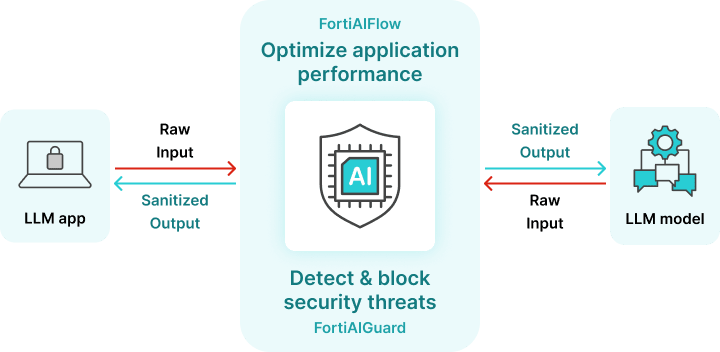
This shift is creating demand for a new category of security solutions. Platforms such as Fortinet’s FortiAI Gate have been designed specifically to provide visibility, policy enforcement and governance for AI applications. FortiAI Gate product overview
The emergence of solutions like FortiAI Gate reflects a broader trend. AI is no longer being treated as an experimental technology. Instead, organisations are beginning to recognise that AI requires the same level of visibility, governance and risk management as any other critical business system.
Emerging risk
Many organisations already have an AI adoption strategy. Far fewer have a strategy for monitoring, governing and securing AI usage across the business.
While this article focuses on how AI is changing the threat landscape, organisations should also consider the risks introduced by their own adoption of AI tools. Have a read of our latest article, where we explore the AI-related cybersecurity risks that business leaders should be aware of.
The future of cyber defence is operational maturity
When new technologies emerge, organisations often focus on the technology itself. Over time, however, the organisations that adapt most successfully tend to focus on operating models rather than individual tools.
Artificial intelligence is unlikely to be any different.
The organisations that gain the greatest benefit from AI will not necessarily be those with the largest security budgets or the most advanced technology stacks. More often, success will come from understanding how AI changes security operations and using it to improve visibility, decision-making and response times.
Human expertise will remain essential. Security professionals provide context, judgement and business understanding that technology cannot replace. However, asking skilled teams to spend their time reviewing large volumes of low-value alerts is neither efficient nor sustainable.
AI can help solve that problem. By reducing manual effort and improving operational efficiency, it allows security teams to focus on the incidents that genuinely require investigation and action.
Ultimately, the future of cyber defence is not about replacing people with technology. It is about combining visibility, automation and human expertise to build a more resilient security operating model.
Frequently asked questions
What are AI-powered cyber attacks?
AI-powered cyber attacks use artificial intelligence to accelerate activities such as phishing, reconnaissance, social engineering and vulnerability research. Rather than creating entirely new attack methods, AI helps attackers work faster, operate at greater scale and adapt their techniques more efficiently.
How are attackers using AI?
Threat actors use AI to generate convincing phishing content, analyse large volumes of information, automate research activities and scale campaigns more efficiently. As a result, attacks can be launched faster and adapted more easily.
Can AI improve cyber defence?
Yes. AI can help organisations analyse large volumes of security data, identify patterns, reduce alert fatigue and prioritise activity that requires investigation. Many modern security platforms now include AI-assisted detection and response capabilities.
What is the difference between SIEM and SOAR?
A SIEM collects, stores and analyses security data from across an environment. A SOAR platform focuses on automating response actions and executing predefined workflows when specific conditions are met.
What is a virtual SOC?
A virtual Security Operations Centre (vSOC) provides monitoring, investigation and escalation services without requiring an organisation to build a dedicated internal SOC. This approach helps improve security coverage while making more efficient use of internal resources.
What is prompt injection?
Prompt injection is a technique used to influence the behaviour of AI systems through carefully crafted inputs. As organisations adopt AI applications, prompt injection is becoming an increasingly important security consideration.
How can organisations prepare for AI-driven cyber threats?
A practical starting point is improving visibility. Organisations should ensure they have appropriate logging, monitoring and detection capabilities in place, understand the business impact of potential incidents and introduce automation where it provides clear operational value.
Want a practical perspective on cybersecurity?
Cybersecurity discussions often focus on technologies, products and emerging threats. In this video, Alan Kepper answers common cybersecurity questions raised by IT leaders and business decision-makers, drawing on more than 40 years of experience across communications, networking and digital infrastructure. Watch the video here
Speak with our team
Most organisations already have many of the technologies required to improve their cyber resilience. The challenge is understanding how those technologies fit together, where visibility gaps exist and which processes can be improved through automation.
If you’re evaluating your organisation’s security maturity, visibility capabilities or approach to security automation, the Laminar team can help identify practical next steps based on your environment, operational requirements and business objectives. Contact our team.
About the author
Alan Kepper is Founder and CEO of Laminar Communications and has more than 40 years of experience across communications, networking and digital infrastructure. With a background in electronic and electrical engineering, Alan has spent his career designing, implementing and operating complex technology environments. Today, he works with organisations across Australia to address infrastructure, cybersecurity and operational resilience challenges through a practical, engineering-led approach to technology decision-making.
READ MORE NEWS
Related Articles

August 24, 2026
How to Adopt AI Safely in Your Business: Inside a CEO’s Real Decision-Making Process
READ ARTICLE
