


How to Adopt AI Safely in Your Business: Inside a CEO’s Real Decision-Making Process
Why Laminar chose Claude over Microsoft Copilot, and the data security rethink that came with it.
Are you trying to bring AI into your business without creating a mess of it? At Laminar, we’ve spent the last year figuring this out and I want to share what we actually did, not just the theory.
The technology has been moving fast, and it’s made a few things genuinely hard to plan for:
- Investing in a tool that becomes cheap or free within six months. Nobody wants to sign a big contract for something that changes shape overnight.
- Training staff on a tool and its rules, only for the tool to change again shortly after. The retraining cost adds up quickly, especially in a larger team.
- Managing the security risk as staff start trusting these tools faster than the business can put guardrails around them.
Why we couldn’t afford to wait
Our people were already using AI — some for work, some for their own projects — well before we had any formal policy in place. That’s not unusual. Most workplaces have some version of this happening right now, often driven by genuine enthusiasm to work smarter and stay competitive.
I’m in the same boat. I use AI in my own work and find it genuinely useful.
Here’s the thing though: if you know your staff are already using AI, doing nothing about it is arguably the riskier choice, not the safer one. So we made a call: it was time to bring AI in properly, with real governance behind it, and we chose Claude, from Anthropic, as our platform.
Choosing an AI platform: Claude vs Microsoft Copilot
Years ago, we built a formal data governance plan to protect our own information and our clients’. A plan built around independent security accreditation, because some of our clients are Government Departments with strict requirements. Bringing AI in meant that plan needed an update, because AI changes what “keeping data safe” actually means (more on that below).
There were two ways we could have approached the rollout: plan everything out in detail before starting (which takes longer to get moving), or start now and adjust as we learn. Because the technology and its risks are changing so quickly, we chose to start now, while updating our formal plan in parallel rather than waiting for it to be finished.
A strong data governance plan is now essential. Discover what an effective data governance strategy should include in 2026 and how our approach helps businesses protect and manage their data.
Direct from Anthropic, or through Microsoft?
You can get access to Claude either directly from Anthropic, or bundled through a Microsoft 365 subscription alongside Teams and Office.
Our first instinct was Microsoft Copilot, simply because it already sits inside the Microsoft tools we use every day. But it turns out Microsoft doesn’t run all of its AI itself either — it also relies on outside providers, with its own trust arrangements around that. Once we looked closely, the real decision wasn’t “Microsoft or someone else” — it was “do we trust Anthropic directly, or trust Microsoft to manage that relationship for us?”

We decided the two were much the same on trust. What actually tipped the decision was speed of access: going directly to Anthropic means we get new Claude features as soon as they’re released, instead of waiting for Microsoft to add them. In a fast-moving space, that mattered more to us than the convenience of one vendor for everything.
The other deciding factor was control: an enterprise-level Claude arrangement gives the whole business the same rules and safeguards automatically, not settings each employee configures for themselves.
In practice, our staff now log into Claude using the same Microsoft login they already use for everything else, and we control what data it can access and how much each person uses.
The real challenge: AI doesn’t just store your information, it acts on it
Bringing in any new system raises the same question we’d ask about a new employee: what should this system be allowed to see? AI adds a second question that older tools never raised: what happens once the system itself starts creating documents and working directly with your business and client information?
Old tools stored information. AI can act on it.
Think about a normal document in Microsoft Word. Word doesn’t need to understand what’s in the file, it just holds it. Keeping it secure is mostly about controlling the file itself: who can open it, whether it’s encrypted, whether you can track or cut off access later. The file is fixed and easy to inspect, which is exactly why traditional classification levels (like “confidential” or “restricted”) work well for this kind of system.
AI changes that in two ways.
First, a model actually processes what’s inside your content, rather than just storing it — which means the security question extends to how that content is processed, not just where it’s stored.
Second, an AI system can act on its own: sending an email, moving a file, triggering another tool. That means the system creating your content can also distribute it, without a person necessarily in the loop at that exact moment.
What this means in practice
The upshot is that protecting sensitive information can no longer rely purely on locking down individual files. It increasingly needs to be a set of rules that travels with the information itself, no matter where it’s being processed; sometimes called a “Zero Trust” approach.
Right now, the practical ways businesses are addressing this include:
- Running AI within an approved, secure environment so sensitive content never leaves a controlled boundary.
- Keeping separate AI setups for different sensitivity levels, so lower-risk and higher-risk information are never handled by the same system.
- Making sure AI can only draw on information a given staff member is actually allowed to see, and that anything it generates carries the same sensitivity level as the information it came from.
- Monitoring what goes in and out of the AI system, similar to how businesses already monitor email and file transfers for sensitive data.
Learn how businesses can address the emerging security risks created by employees’ use of AI tools in our article, [The Four Core AI Security Risks Facing Enterprises Today].
The parts nobody has fully solved yet
A few genuinely hard problems remain open across the industry, and they’re worth knowing about even if you’re not deep in security work:
- A single conversation can mix sensitive and non-sensitive topics, and there’s no clean way yet to separate them automatically.
- If AI summarises something sensitive, how sensitive is the summary? Nobody has a fully settled answer.
- AI can combine several harmless-looking facts into a conclusion that, together, is actually sensitive, without anyone intending that to happen.
- Ultimately, a person is still legally responsible for classifying information correctly. A system can’t be held accountable the way a person can.
Securing an AI system means securing something that can think about your information and act on it, which is a much bigger job than securing a filing cabinet ever was. We’re going into this expecting our first version of the plan to be imperfect, and improving it as we go, rather than waiting for a perfect plan before starting.

What guided our approach: Australia’s Protective Security Policy Framework (PSPF)
We didn’t want to invent our security approach from scratch, so we used the Australian Government’s Protective Security Policy Framework (PSPF) as a reference point. It’s the framework Australian Government agencies use to protect their people, information, and resources, organised into six areas: governance, risk, information, technology, personnel, and physical security.
We’re not a government agency, and the full framework is far more than a business our size needs. But it’s a genuinely useful starting point for thinking through AI adoption, particularly around two areas:
- Information handling — making sure AI only works with information a person is cleared to access, and that anything it produces is treated with the same care as its source material.
- Technology security — making sure AI systems themselves are accounted for in the business’s overall security planning, the same way any other software would be.
(A note for anyone checking this in detail: government security frameworks like the PSPF update on an annual cycle, so always confirm the current version and its effective date directly, rather than relying on a specific date quoted secondhand.)
What’s next for Laminar
The bigger an organisation, the more formal its information security processes usually need to be — which is exactly why the full government framework doesn’t make sense for a business our size. We’re adopting the parts of it that are genuinely useful and practical, rather than the whole thing.
Bringing AI into a business puts real pressure on how you’ve traditionally thought about protecting information. Our existing data governance plan was our starting point, not the finished article. While we build this out step by step, our first move has been to separate our most sensitive information into an environment we control completely, away from the broader AI rollout, while we mature our approach.
The part I find genuinely fascinating, and where we’re focusing next, is what happens at the exact moment new content gets created, not just where it ends up being stored.
For a deeper understanding of the threats associated with enterprise AI adoption, explore the key AI cybersecurity risks businesses should prepare for.
Adopting AI across your business?
If your organisation is implementing AI at a company-wide level and needs support reviewing, updating or developing its Data Governance plan, our team can help.
Leave your details below, and Laminar’s strategic team will contact you to arrange a complimentary initial consultation.
Form blogs
"*" indicates required fields
Form blogs
"*" indicates required fields
Frequently Asked Questions
Do I need a formal AI policy before letting my employees use AI tools?
Ideally yes, but don’t let a lack of a finished policy stop you from acting. If your staff are already using AI tools informally — which is common — it’s usually safer to introduce basic guardrails immediately (approved tools, login controls, usage guidelines) while you develop a fuller policy, rather than waiting until the policy is complete.
Should I choose Claude, ChatGPT or Microsoft Copilot for my business?
It depends on your existing setup and priorities. Copilot has the advantage of sitting inside a Microsoft 365 subscription you may already have. Going directly to Anthropic for Claude can mean faster access to new features, while still letting staff log in with their existing Microsoft account. Every tool can offer strong business-wide controls, the right choice often comes down to how quickly you want new capability versus the convenience of one vendor.
How does using AI change how I need to protect my business’s information?
Traditional file security focuses on protecting a document while it’s stored or sent. AI tools actively process the content inside your documents and can act on it — for example, drafting a reply or moving information between systems — so protection needs to extend to how that content is processed, not only where it’s stored.
Do I need government-level security accreditation to use AI safely in my business?
No — accreditations like Australia’s PSPF are built for government agencies and are more extensive than most private businesses need. However, the underlying principles (know what information your AI tools can access, and treat anything they produce with the same care as its source) are useful for any business, regardless of size.
What’s the biggest risk of not having any AI governance at all?
The most common risk is invisible use: staff already using AI tools with company or client information, without any guidelines around what’s appropriate, which tools are approved, or how sensitive information should be handled. Bringing that activity under a light governance structure early is usually far easier than trying to unwind bad habits later.
READ MORE NEWS
Related Articles


May 12, 2026
AI Cybersecurity Risks Every Business Leader Must Address in 2027
READ ARTICLE
Why AI-powered cyber attacks are outpacing human defenders
Artificial intelligence is changing the speed and scale of modern cyber threats, making AI-powered cyber attacks a growing concern for organisations across Australia.
Over the last four decades, organisations have adapted to several major technology shifts. The rise of the internet, mobile devices, cloud computing, software-defined infrastructure and remote work have all changed how businesses operate and how technology environments are designed, managed and secured. Each of these developments delivered clear operational and commercial benefits, but they also introduced new dependencies, new risks and new opportunities for attackers.
Artificial intelligence is creating a similar transition. Most organisations are currently focused on the productivity benefits that AI can deliver, whether that involves analysing information more quickly, automating repetitive tasks or helping employees make better use of their time. At the same time, attackers are applying many of the same capabilities to activities such as reconnaissance, phishing, vulnerability research and social engineering.
Recent guidance published by the Australian Signals Directorate (ASD) highlights this dual reality. AI has the potential to support defenders by improving threat detection, accelerating investigation processes and reducing the manual effort associated with routine security tasks. However, the same technology can also help threat actors operate more efficiently by reducing the effort required to research targets, develop campaigns and adapt their techniques.

Image: ASD – Integrating AI for cyber security
Australian Signals Directorate guidance on AI in cyber defence
For technology leaders, the question is no longer whether AI will influence cybersecurity. Most organisations are already seeing evidence of that change. A more practical consideration is how security operations need to evolve when attackers can gather information faster, create more convincing content and execute activities at a scale that was previously difficult to achieve.
How AI-powered cyber attacks are changing the cyber threat landscape
One of the key observations in the ASD guidance is that artificial intelligence is not creating an entirely new category of cyber threats. Many of the techniques associated with AI-powered attacks, including phishing, reconnaissance and social engineering, have existed for years. What is changing is the speed, scale and efficiency with which those techniques can be executed.
For most organisations, this is a more immediate concern than highly sophisticated AI-driven attack scenarios. Existing attack methods are becoming easier to execute, more scalable and harder to manage through traditional security operations.
Phishing is a good example. AI can help attackers generate convincing content, adapt messaging to different audiences and produce campaigns at a scale that would previously have required significantly more effort. Similarly, AI can accelerate reconnaissance activities by analysing large volumes of publicly available information and identifying potential opportunities much faster than a person could.
Rather than introducing entirely new attack methods, AI is helping threat actors execute familiar techniques more efficiently. As a result, security teams have less time to identify suspicious activity and respond before an incident develops into a larger operational issue.
Key takeaway
AI is not creating entirely new cyber threats. It is accelerating existing attack techniques and allowing threat actors to operate faster, at greater scale and with less effort than before.
Many security programs were designed around a different operating rhythm. Historically, security teams had more time to investigate alerts, validate concerns and escalate issues before significant damage occurred. As attackers become more efficient and attack volumes increase, that assumption becomes increasingly difficult to rely upon. Consequently, organisations need to think not only about preventing attacks, but also about whether their security operations model is capable of responding at the speed required today.
Why traditional security operations struggle against AI-driven cyber attacks
Most organisations have invested heavily in cybersecurity over the past decade. Firewalls, endpoint protection platforms, identity management systems, email security tools and vulnerability management programs are now standard components of modern IT environments. While these technologies provide valuable visibility, they also generate a significant amount of security data.
The challenge for many organisations is no longer collecting information. Firewalls generate logs, endpoint platforms generate alerts, identity systems record authentication activity and cloud platforms produce audit events. Together, these data sources can create an overwhelming volume of information that becomes difficult to interpret without the right operational processes in place.
As attackers become faster and more efficient, security teams are expected to review increasing volumes of activity while operating with largely unchanged resources. Many organisations already have access to the information needed to identify threats, but determining which events require immediate attention and which represent normal activity can be time-consuming.
Adding more people does not always solve the problem. Experienced security professionals remain essential, but larger teams often inherit larger workloads when the underlying processes for identifying, prioritising and responding to threats remain unchanged.
For this reason, AI-assisted detection, event correlation and automation are becoming increasingly important within modern security operations. Their purpose is not to replace people. Instead, they help organisations process larger volumes of information more efficiently and ensure that human attention is focused on incidents that genuinely require investigation and judgement.
The organisations achieving the best outcomes are not choosing between people and technology. They are combining both to improve visibility, reduce operational noise and respond more effectively to potential threats.
As AI-powered cyber attacks continue to evolve, organisations need security operations that can detect, prioritise and respond to threats more efficiently.
Financial services offer a glimpse of what is coming
Although AI-driven security challenges affect organisations across every industry, financial services provide a useful indication of where cyber resilience expectations are heading. Banks, insurers and financial institutions operate in highly regulated environments, manage sensitive data and depend on complex digital systems to deliver core services.
For that reason, regulators tend to scrutinise not only whether financial organisations can prevent cyber incidents, but whether they can continue operating when incidents occur. This is an important shift. Cybersecurity is no longer being assessed only as a technical control issue. It is increasingly being treated as an operational resilience issue.
Recent commentary from ASIC reflects this broader direction. The financial services sector is being pushed to think more clearly about cyber risk, business continuity, governance and the consequences of failing to respond effectively when incidents occur.
ASIC commentary on cyber resilience and operational risk
Although these conversations are particularly visible within financial services, the underlying principles apply across many other sectors. Education providers, healthcare organisations, government agencies, manufacturers and professional services firms all depend on technology to deliver critical services. In each case, the organisation needs to understand which systems are essential, how long disruption can be tolerated and what actions should be taken if those systems become unavailable.
Question for leadership teams
If a critical business system became unavailable tomorrow, how long could your organisation continue operating effectively?
The question every organisation should be asking
Many cybersecurity conversations still begin with tools. Organisations ask whether they need a new firewall, a new endpoint platform, a SIEM, a SOC service or a SOAR capability. These are valid questions, but they are not always the best starting point.
A more useful starting point is to work backwards from the impact of an incident. If an attacker gained access to a critical system, what would happen next? Rather than focusing solely on the technical compromise, organisations should consider the operational consequences. Which systems could be affected? Would any services need to be isolated? Who would need to be informed? And which actions would need to happen immediately to reduce business impact?
This approach changes the conversation. Instead of treating cybersecurity as a collection of products, it treats it as an operating model. The objective becomes understanding how the organisation detects issues, decides what matters and responds in a way that limits business impact.
That operating model depends on visibility. Without visibility, an organisation cannot confidently understand what is happening. Without that understanding, it is difficult to prioritise risks or automate response actions safely.
This is where many organisations need to focus before moving too quickly into advanced automation. Automation is only useful when the organisation has enough context to know what should happen when specific conditions occur.
A practical roadmap for defending against AI-assisted attacks
For most organisations, the move towards AI-assisted cyber defence should happen in phases. Attempting to automate response actions before establishing visibility and context can create operational risk. A more practical approach is to build maturity progressively.
| Stage | Objective |
|---|---|
| Visibility | Understand what is happening across the environment |
| Understanding | Assess business impact and operational risk |
| AI-assisted operations | Prioritise, correlate and investigate activity faster |
| Automated response | Execute approved actions consistently and quickly |
Stage 1: Visibility
Visibility is the foundation of modern cyber defence. Organisations need to understand what is happening across users, devices, applications, cloud services, network infrastructure and security controls.
This is where a SIEM becomes important. A well-implemented SIEM collects and centralises security telemetry, giving teams a clearer view of activity across the environment. It also creates the data foundation required for later stages of maturity, including AI-assisted analysis and automated response.
For organisations looking to centralise security visibility and improve their ability to detect meaningful activity, Lumenir provides a practical foundation for modern security operations.
Visibility remains one of the most important requirements for detecting AI-powered cyber attacks before they escalate.
Stage 2: Understanding
Visibility alone is not enough. Once information is being collected, the organisation needs to understand what that information means in a business context.
This means identifying critical systems, understanding dependencies, defining acceptable downtime and mapping the potential impact of different incident scenarios. A security alert affecting a low-risk system does not carry the same operational consequence as suspicious activity involving identity systems, finance platforms or core infrastructure.
This stage is important because it informs response decisions. If an organisation understands the potential blast radius of an incident, it can make better decisions about escalation, containment and recovery.
Stage 3: AI-assisted operations
Once visibility and context are established, AI-assisted operations can help security teams work more efficiently. This may include event correlation, anomaly detection, alert prioritisation and noise reduction.
Many organisations do not have the internal resources to monitor security activity continuously or investigate every alert in depth. A virtual Security Operations Centre, or vSOC, can help by providing monitoring, triage and escalation support without requiring the organisation to build a full internal SOC capability.
Explore Virtual SOC and incident response service.
The purpose of AI-assisted operations is not to remove humans from the process. It is to ensure human attention is directed towards activity that genuinely requires investigation and judgement.
This capability becomes increasingly valuable as organisations face a growing volume of AI-powered cyber attacks.
Stage 4: Automated response
Automated response is the stage many organisations associate with SOAR. A SOAR platform allows approved response actions to be executed automatically when specific conditions are met.
For example, if a user account shows behaviour consistent with compromise, an approved playbook may trigger account suspension or forced password reset. If suspicious activity is detected on a critical system, segmentation or isolation steps may be initiated. If indicators of ransomware behaviour appear, predefined containment actions can begin before the incident spreads further.
The important point is that automation should not be uncontrolled. It should be based on approved playbooks, agreed thresholds and clear operational rules. The value of SOAR is that it allows known response actions to happen quickly and consistently when time matters.
Cyber defence maturity model
Visibility → Understanding → AI-assisted operations → Automated response
You cannot automate what you cannot see, and you cannot confidently respond to risks you do not understand.
Securing AI is becoming part of the challenge
While much of the cybersecurity discussion focuses on how attackers are using AI, organisations are increasingly facing a second challenge: securing their own use of AI.
Over the last two years, tools such as ChatGPT, Microsoft Copilot and Gemini have moved rapidly into everyday business operations. In many organisations, employees are already using AI to analyse information, generate content and improve productivity. However, governance frameworks and security controls have not always evolved at the same pace.
As adoption increases, organisations need to understand what information is being shared with AI platforms, how those platforms are being used and whether appropriate controls are in place. Questions around data leakage, prompt injection, access control and AI governance are becoming increasingly relevant.
This shift is creating demand for a new category of security solutions. Platforms such as Fortinet’s FortiAI Gate have been designed specifically to provide visibility, policy enforcement and governance for AI applications. FortiAI Gate product overview
The emergence of solutions like FortiAI Gate reflects a broader trend. AI is no longer being treated as an experimental technology. Instead, organisations are beginning to recognise that AI requires the same level of visibility, governance and risk management as any other critical business system.
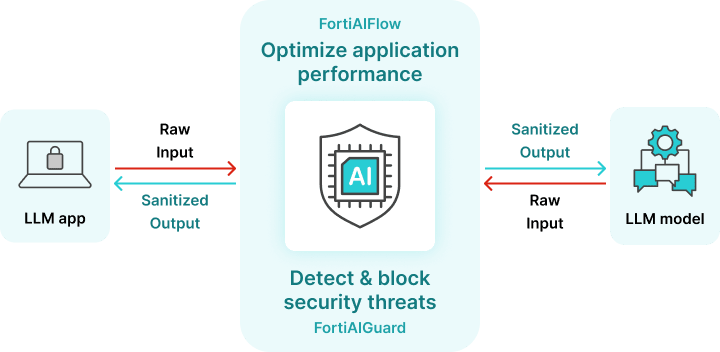
Emerging risk
Many organisations already have an AI adoption strategy. Far fewer have a strategy for monitoring, governing and securing AI usage across the business.
While this article focuses on how AI is changing the threat landscape, organisations should also consider the risks introduced by their own adoption of AI tools. Have a read of our latest article, where we explore the AI-related cybersecurity risks that business leaders should be aware of.
The future of cyber defence is operational maturity
When new technologies emerge, organisations often focus on the technology itself. Over time, however, the organisations that adapt most successfully tend to focus on operating models rather than individual tools.
Artificial intelligence is unlikely to be any different.
The organisations that gain the greatest benefit from AI will not necessarily be those with the largest security budgets or the most advanced technology stacks. More often, success will come from understanding how AI changes security operations and using it to improve visibility, decision-making and response times.
Human expertise will remain essential. Security professionals provide context, judgement and business understanding that technology cannot replace. However, asking skilled teams to spend their time reviewing large volumes of low-value alerts is neither efficient nor sustainable.
AI can help solve that problem. By reducing manual effort and improving operational efficiency, it allows security teams to focus on the incidents that genuinely require investigation and action.
Ultimately, the future of cyber defence is not about replacing people with technology. It is about combining visibility, automation and human expertise to build a more resilient security operating model.
Frequently asked questions
What are AI-powered cyber attacks?
AI-powered cyber attacks use artificial intelligence to accelerate activities such as phishing, reconnaissance, social engineering and vulnerability research. Rather than creating entirely new attack methods, AI helps attackers work faster, operate at greater scale and adapt their techniques more efficiently.
How are attackers using AI?
Threat actors use AI to generate convincing phishing content, analyse large volumes of information, automate research activities and scale campaigns more efficiently. As a result, attacks can be launched faster and adapted more easily.
Can AI improve cyber defence?
Yes. AI can help organisations analyse large volumes of security data, identify patterns, reduce alert fatigue and prioritise activity that requires investigation. Many modern security platforms now include AI-assisted detection and response capabilities.
What is the difference between SIEM and SOAR?
A SIEM collects, stores and analyses security data from across an environment. A SOAR platform focuses on automating response actions and executing predefined workflows when specific conditions are met.
What is a virtual SOC?
A virtual Security Operations Centre (vSOC) provides monitoring, investigation and escalation services without requiring an organisation to build a dedicated internal SOC. This approach helps improve security coverage while making more efficient use of internal resources.
What is prompt injection?
Prompt injection is a technique used to influence the behaviour of AI systems through carefully crafted inputs. As organisations adopt AI applications, prompt injection is becoming an increasingly important security consideration.
How can organisations prepare for AI-driven cyber threats?
A practical starting point is improving visibility. Organisations should ensure they have appropriate logging, monitoring and detection capabilities in place, understand the business impact of potential incidents and introduce automation where it provides clear operational value.
Want a practical perspective on cybersecurity?
Cybersecurity discussions often focus on technologies, products and emerging threats. In this video, Alan Kepper answers common cybersecurity questions raised by IT leaders and business decision-makers, drawing on more than 40 years of experience across communications, networking and digital infrastructure. Watch the video here
Speak with our team
Most organisations already have many of the technologies required to improve their cyber resilience. The challenge is understanding how those technologies fit together, where visibility gaps exist and which processes can be improved through automation.
If you’re evaluating your organisation’s security maturity, visibility capabilities or approach to security automation, the Laminar team can help identify practical next steps based on your environment, operational requirements and business objectives. Contact our team.
READ MORE NEWS
Related Articles
August 24, 2026
How to Adopt AI Safely in Your Business: Inside a CEO’s Real Decision-Making Process
READ ARTICLE
May 12, 2026
AI Cybersecurity Risks Every Business Leader Must Address in 2027
READ ARTICLE
Organisations everywhere are racing to adopt AI, but AI cybersecurity risks are growing faster than most businesses realise. Here’s what’s at stake, what’s already being exploited, and how to govern AI before it governs you.
Table of Contents
- The Rush to Trust AI—and Why It’s Dangerous
- The Four Core AI Security Risks Facing Enterprises Today
- How AI Is Reshaping the Threat Landscape
- AI Cybersecurity Risks vs Defence: Where Threat Detection Is Heading (2025–2027)
- Why Data Sovereignty Is the Non-Negotiable Foundation
- The Human Challenge: Are We Ready for Automated IT Operations?
- What Business Leaders Should Do Right Now
The Rush to Trust AI and Why It’s Dangerous
Organisations everywhere are racing to adopt AI. But AI cybersecurity risks are growing faster than most businesses realise. Tools that promise to supercharge productivity, automate workflows, and unlock new business insights are landing on desks faster than IT teams can evaluate them. But there’s an uncomfortable truth hiding inside that momentum: the very technology transforming your business is also quietly rewriting the rules of cybersecurity, for attackers and defenders alike.
Last week, at a cybersecurity conference, I came across an article about the rapid uptake of OpenClaw. Within minutes, my threat intelligence feed surfaced a detailed walkthrough from the hacker community on how to attack and manipulate it. It wasn’t sophisticated. It wasn’t even hard to do.
We’ve seen this movie before. Shadow IT exploded with cloud storage. Now it’s back at a scale and speed that makes the last wave look manageable.
The gap between threat evolution and organisational readiness is widening fast. As someone who has spent years in enterprise IT and security architecture, I’m watching this unfold with serious concern. The window to close that gap is still open, but only if we act with urgency and clarity.
The Four Core AI Cybersecurity Risks Facing Enterprises Today
1. Shadow AI: The New Shadow IT
Employees are connecting company data to public large language models (LLMs), agentic platforms, and “productivity boosters” without any IT oversight. Sensitive emails, customer records, and strategic documents are being fed into models that the business doesn’t own, audit, or control.
The result: Corporate and personal data leakage at scale. These are among the most underestimated AI cybersecurity risks facing organisations today. Once information is connected to an unvetted AI, it can be read, summarised, stored, or manipulated—often without any visible footprint.
Quick definition: Shadow AI refers to the unsanctioned use of artificial intelligence tools by employees without IT knowledge or approval—a direct evolution of the Shadow IT problem, but with significantly higher data exposure risk.
2. Model Poisoning and Training Data Attacks
Malicious actors are actively injecting poisoned data into AI training pipelines and live agent interactions. A single compromised dataset or crafted prompt can corrupt an entire AI-driven workflow downstream.
The risk compounds because today’s AI tools are designed to maximise connectivity. More integration means more attack surface. More attack surface means more opportunity for data exposure—often before any alert fires.
3. Prompt Injection in Agentic Systems
This is the risk that keeps security architects up at night.
Agentic AI tools—platforms like OpenClaw and its growing ecosystem of variants (ClawBro, MyClaw, and others) that let users build automated processes connected to email, calendars, internal databases, and cloud services are inherently vulnerable to prompt injection attacks. A malicious instruction, embedded inside an ordinary-looking email or document, can hijack the agent’s behaviour entirely.
The agent executes the instruction at machine speed: exfiltrating data, triggering ransomware, or pivoting deeper into the network before a human analyst has even opened their laptop. These are not theoretical scenarios. They are happening now.
What makes this especially dangerous: many organisations have no visibility into what their agentic tools are actually doing at runtime.
Australia’s own cyber security authority has issued specific guidance on the careful adoption of agentic AI services — a clear signal that this is no longer a niche technical concern.
4. Opaque, Unvetted AI Ecosystems
Many of the most widely-adopted agentic platforms have no clearly identifiable corporate owner, no transparent hosting location, and no verifiable security posture. OpenClaw, for example, is an open-source project that lets anyone run powerful agents locally or in the cloud. Great for speed but a governance vacuum. How do you perform due diligence when you can’t even identify who’s ultimately responsible for the platform your workflows depend on?
Independent evaluations, such as AISI’s assessment of frontier AI cyber capabilities, confirm that the gap between what these models can do and what organisations assume they can do is significant — and growing.
Shadow IT, LLM injection, model poisoning, and data exposure are no longer edge cases. These AI cybersecurity risks are the new baseline threat for any organisation running AI workloads.

How AI Is Reshaping the Threat Landscape
AI isn’t just a tool for defenders. Attackers are using it to move faster, stay hidden longer, and strike more precisely.
- Sleeper compromises are planted months in advance, activating only when conditions are right—long after the initial breach goes undetected.
- AI-generated phishing is now indistinguishable from legitimate correspondence at scale — and attackers are already using it for mass exploitation events, as Google publicly documented it just this past week.
- Deepfake voice and video attacks are being used in business email compromise (BEC) and executive impersonation fraud.
- Supply-chain attacks on AI components are increasing in frequency and sophistication—targeting the models and libraries organisations depend on, not just their endpoints.
The rate of change here is not linear. Traditional perimeter defences were not designed for a world where an attacker can operate inside your AI workflows. Ignoring AI cybersecurity risks at board level is no longer an oversight, it’s a strategic liability. The Australian Signals Directorate has assessed the impact directly: frontier AI models are already reshaping the cybersecurity threat landscape in ways that traditional defences were never designed to handle.
AI Cybersecurity Risks vs Defence: Where Threat Detection Is Heading (2025–2027)
Predicting the exact trajectory is genuinely difficult—the pace of change is too high for precision forecasting. But the directional picture is clear, and the foundation is always the same: data architecture.
Real-Time Visibility Is Non-Negotiable
Modern SIEM (Security Information and Event Management) platforms that collect, correlate, and protect logs in real time give organisations the raw material for meaningful threat detection. Without this foundation, you are flying blind. Every other AI-powered security capability sits on top of it.
Corporate Data Lakes as Crown Jewels
Your historical and real-time operational data is now a strategic asset—and a high-value target. Organisations that invest in governed, sovereign data lakes today are building the infrastructure that future AI security tools will depend on. Those that don’t are accumulating invisible technical and security debt.
Agent-to-Agent Firewalls and Next-Generation DLP
A new category of security tooling is emerging: virtual AI firewalls that sit between your agentic systems and the outside world, inspecting prompts, outputs, and data flows in real time. These platforms can detect and block model-poisoning attempts, flag anomalous agent behaviour, and enforce data loss prevention (DLP) at the AI layer—not just at the network perimeter.
Having seen several of these platforms demonstrated recently, they represent the evolution DLP should have undergone years ago.
SOAR + AI: From Detection to Automated Response
SOAR (Security Orchestration, Automation and Response) platforms, combined with specialised AI tooling, are enabling a step-change in incident response. Detection is the starting point. The real value is in automated triage, containment, and remediation, reducing response times from hours to minutes, at a consistency no purely human team can match.
The prerequisite, always, is trustworthy underlying data.
Why Data Sovereignty Is the Non-Negotiable Foundation
When automated systems make security decisions—or trigger automated responses—the integrity of the data feeding those decisions is everything.
A poisoned data lake doesn’t just corrupt your analytics. It can turn your AI-powered defender into an unwitting accomplice, causing your systems to react to manufactured threats while real ones go undetected. In critical infrastructure contexts, the consequences of this are severe.
Data sovereignty isn’t about isolation. It’s about control and verification. It means knowing where your data is processed, who can access it, and whether it has been tampered with. It’s the difference between responding to a real threat and being manipulated into attacking yourself.
The playbook already exists and sovereign defence organisations have been solving this problem for decades. The enterprise sector needs to apply those same principles to AI governance now, not after the first major incident.
The Human Challenge: Are We Ready for Automated IT Operations?
Here’s the part most technology vendors prefer not to discuss: the biggest risk isn’t the AI itself—it’s the humans racing to adopt it without changing how they think.
I use an analogy from mathematics. When you study calculus, the conceptual leap isn’t just learning new formulas—it’s learning to think in terms of rates of change rather than static positions. Position, velocity, acceleration. Most organisations are still operating in the position plane: reacting to where threats are, not where they’re going.
AI forces a shift to the acceleration plane. It demands that security teams—and the leaders above them—develop intuition for rates of change, not just current states. The same cognitive shift happened when calculators entered the workplace. We didn’t stop doing mathematics; we moved up a level of abstraction.
Most organisations are not yet ready for the full automation of IT security operations. The “rush to trust” culture is recreating the Shadow IT headaches we thought were solved a decade ago. But the organisations that will emerge strongest are those treating this moment as a leadership and cultural challenge, not just a procurement decision.
AI handles velocity and volume. Humans provide context, ethics, and strategic judgment. The goal is not to replace one with the other—it’s to combine them so that both response times and decision quality improve simultaneously.
What Business Leaders Should Do Right Now
The window to close the gap between AI adoption and AI governance is still open. Here’s where to focus:
- Establish clear AI governance policies. Define which tools are sanctioned, which data they can access, and what oversight exists. No exceptions for productivity gains.
- Invest in modern data architecture now. A governed, sovereign data lake is the foundation for every AI security capability you will need in the next three years. Build it before you need it.
- Deploy layered AI security tooling. SIEM, SOAR, and next-generation AI firewalls and DLP are not optional for organisations running agentic workloads. Protect the workflows, not just the perimeter. (If you’re looking for a managed starting point, our Lumenir service brings all of this together as a single, governed cybersecurity-as-a-service offering.)
- Insist on data sovereignty for automated decision systems. Any system that makes or triggers automated responses must have auditable, verified data provenance. No exceptions.
- Train your people to think in the acceleration plane. Security awareness is no longer enough. Your teams need to understand AI-specific attack vectors, question the provenance of every new tool, and develop intuition for how fast the threat landscape is moving.
The Bottom Line
AI is not a future risk. It is a present one already being exploited, already widening the gap between organisations that govern it and those that don’t.
The balance every business leader needs to strike is precise: address AI cybersecurity risks head-on and turn AI into a force multiplier for your capabilities — not an invisible backdoor for attackers. That balance is achievable. But it requires treating AI security as a board-level strategic priority today—not after the first incident, and not after the governance conversation becomes unavoidable.
The organisations that act now will be the ones still standing—and genuinely thriving—when the dust settles.
Ready to close the gap between AI adoption and AI security? Talk to the Laminar team. We’ll help you build a governance framework that protects your AI workloads without slowing your business down.
READ MORE NEWS
Related Articles
August 24, 2026
How to Adopt AI Safely in Your Business: Inside a CEO’s Real Decision-Making Process
READ ARTICLE