


Why AI-powered cyber attacks are outpacing human defenders
Artificial intelligence is changing the speed and scale of modern cyber threats, making AI-powered cyber attacks a growing concern for organisations across Australia.
Over the last four decades, organisations have adapted to several major technology shifts. The rise of the internet, mobile devices, cloud computing, software-defined infrastructure and remote work have all changed how businesses operate and how technology environments are designed, managed and secured. Each of these developments delivered clear operational and commercial benefits, but they also introduced new dependencies, new risks and new opportunities for attackers.
Artificial intelligence is creating a similar transition. Most organisations are currently focused on the productivity benefits that AI can deliver, whether that involves analysing information more quickly, automating repetitive tasks or helping employees make better use of their time. At the same time, attackers are applying many of the same capabilities to activities such as reconnaissance, phishing, vulnerability research and social engineering.
Recent guidance published by the Australian Signals Directorate (ASD) highlights this dual reality. AI has the potential to support defenders by improving threat detection, accelerating investigation processes and reducing the manual effort associated with routine security tasks. However, the same technology can also help threat actors operate more efficiently by reducing the effort required to research targets, develop campaigns and adapt their techniques.

Image: ASD – Integrating AI for cyber security
Australian Signals Directorate guidance on AI in cyber defence
For technology leaders, the question is no longer whether AI will influence cybersecurity. Most organisations are already seeing evidence of that change. A more practical consideration is how security operations need to evolve when attackers can gather information faster, create more convincing content and execute activities at a scale that was previously difficult to achieve.
How AI-powered cyber attacks are changing the cyber threat landscape
One of the key observations in the ASD guidance is that artificial intelligence is not creating an entirely new category of cyber threats. Many of the techniques associated with AI-powered attacks, including phishing, reconnaissance and social engineering, have existed for years. What is changing is the speed, scale and efficiency with which those techniques can be executed.
For most organisations, this is a more immediate concern than highly sophisticated AI-driven attack scenarios. Existing attack methods are becoming easier to execute, more scalable and harder to manage through traditional security operations.
Phishing is a good example. AI can help attackers generate convincing content, adapt messaging to different audiences and produce campaigns at a scale that would previously have required significantly more effort. Similarly, AI can accelerate reconnaissance activities by analysing large volumes of publicly available information and identifying potential opportunities much faster than a person could.
Rather than introducing entirely new attack methods, AI is helping threat actors execute familiar techniques more efficiently. As a result, security teams have less time to identify suspicious activity and respond before an incident develops into a larger operational issue.
Key takeaway
AI is not creating entirely new cyber threats. It is accelerating existing attack techniques and allowing threat actors to operate faster, at greater scale and with less effort than before.
Many security programs were designed around a different operating rhythm. Historically, security teams had more time to investigate alerts, validate concerns and escalate issues before significant damage occurred. As attackers become more efficient and attack volumes increase, that assumption becomes increasingly difficult to rely upon. Consequently, organisations need to think not only about preventing attacks, but also about whether their security operations model is capable of responding at the speed required today.
Why traditional security operations struggle against AI-driven cyber attacks
Most organisations have invested heavily in cybersecurity over the past decade. Firewalls, endpoint protection platforms, identity management systems, email security tools and vulnerability management programs are now standard components of modern IT environments. While these technologies provide valuable visibility, they also generate a significant amount of security data.
The challenge for many organisations is no longer collecting information. Firewalls generate logs, endpoint platforms generate alerts, identity systems record authentication activity and cloud platforms produce audit events. Together, these data sources can create an overwhelming volume of information that becomes difficult to interpret without the right operational processes in place.
As attackers become faster and more efficient, security teams are expected to review increasing volumes of activity while operating with largely unchanged resources. Many organisations already have access to the information needed to identify threats, but determining which events require immediate attention and which represent normal activity can be time-consuming.
Adding more people does not always solve the problem. Experienced security professionals remain essential, but larger teams often inherit larger workloads when the underlying processes for identifying, prioritising and responding to threats remain unchanged.
For this reason, AI-assisted detection, event correlation and automation are becoming increasingly important within modern security operations. Their purpose is not to replace people. Instead, they help organisations process larger volumes of information more efficiently and ensure that human attention is focused on incidents that genuinely require investigation and judgement.
The organisations achieving the best outcomes are not choosing between people and technology. They are combining both to improve visibility, reduce operational noise and respond more effectively to potential threats.
As AI-powered cyber attacks continue to evolve, organisations need security operations that can detect, prioritise and respond to threats more efficiently.
Financial services offer a glimpse of what is coming
Although AI-driven security challenges affect organisations across every industry, financial services provide a useful indication of where cyber resilience expectations are heading. Banks, insurers and financial institutions operate in highly regulated environments, manage sensitive data and depend on complex digital systems to deliver core services.
For that reason, regulators tend to scrutinise not only whether financial organisations can prevent cyber incidents, but whether they can continue operating when incidents occur. This is an important shift. Cybersecurity is no longer being assessed only as a technical control issue. It is increasingly being treated as an operational resilience issue.
Recent commentary from ASIC reflects this broader direction. The financial services sector is being pushed to think more clearly about cyber risk, business continuity, governance and the consequences of failing to respond effectively when incidents occur.
ASIC commentary on cyber resilience and operational risk
Although these conversations are particularly visible within financial services, the underlying principles apply across many other sectors. Education providers, healthcare organisations, government agencies, manufacturers and professional services firms all depend on technology to deliver critical services. In each case, the organisation needs to understand which systems are essential, how long disruption can be tolerated and what actions should be taken if those systems become unavailable.
Question for leadership teams
If a critical business system became unavailable tomorrow, how long could your organisation continue operating effectively?
The question every organisation should be asking
Many cybersecurity conversations still begin with tools. Organisations ask whether they need a new firewall, a new endpoint platform, a SIEM, a SOC service or a SOAR capability. These are valid questions, but they are not always the best starting point.
A more useful starting point is to work backwards from the impact of an incident. If an attacker gained access to a critical system, what would happen next? Rather than focusing solely on the technical compromise, organisations should consider the operational consequences. Which systems could be affected? Would any services need to be isolated? Who would need to be informed? And which actions would need to happen immediately to reduce business impact?
This approach changes the conversation. Instead of treating cybersecurity as a collection of products, it treats it as an operating model. The objective becomes understanding how the organisation detects issues, decides what matters and responds in a way that limits business impact.
That operating model depends on visibility. Without visibility, an organisation cannot confidently understand what is happening. Without that understanding, it is difficult to prioritise risks or automate response actions safely.
This is where many organisations need to focus before moving too quickly into advanced automation. Automation is only useful when the organisation has enough context to know what should happen when specific conditions occur.
A practical roadmap for defending against AI-assisted attacks
For most organisations, the move towards AI-assisted cyber defence should happen in phases. Attempting to automate response actions before establishing visibility and context can create operational risk. A more practical approach is to build maturity progressively.
| Stage | Objective |
|---|---|
| Visibility | Understand what is happening across the environment |
| Understanding | Assess business impact and operational risk |
| AI-assisted operations | Prioritise, correlate and investigate activity faster |
| Automated response | Execute approved actions consistently and quickly |
Stage 1: Visibility
Visibility is the foundation of modern cyber defence. Organisations need to understand what is happening across users, devices, applications, cloud services, network infrastructure and security controls.
This is where a SIEM becomes important. A well-implemented SIEM collects and centralises security telemetry, giving teams a clearer view of activity across the environment. It also creates the data foundation required for later stages of maturity, including AI-assisted analysis and automated response.
For organisations looking to centralise security visibility and improve their ability to detect meaningful activity, Lumenir provides a practical foundation for modern security operations.
Visibility remains one of the most important requirements for detecting AI-powered cyber attacks before they escalate.
Stage 2: Understanding
Visibility alone is not enough. Once information is being collected, the organisation needs to understand what that information means in a business context.
This means identifying critical systems, understanding dependencies, defining acceptable downtime and mapping the potential impact of different incident scenarios. A security alert affecting a low-risk system does not carry the same operational consequence as suspicious activity involving identity systems, finance platforms or core infrastructure.
This stage is important because it informs response decisions. If an organisation understands the potential blast radius of an incident, it can make better decisions about escalation, containment and recovery.
Stage 3: AI-assisted operations
Once visibility and context are established, AI-assisted operations can help security teams work more efficiently. This may include event correlation, anomaly detection, alert prioritisation and noise reduction.
Many organisations do not have the internal resources to monitor security activity continuously or investigate every alert in depth. A virtual Security Operations Centre, or vSOC, can help by providing monitoring, triage and escalation support without requiring the organisation to build a full internal SOC capability.
Explore Virtual SOC and incident response service.
The purpose of AI-assisted operations is not to remove humans from the process. It is to ensure human attention is directed towards activity that genuinely requires investigation and judgement.
This capability becomes increasingly valuable as organisations face a growing volume of AI-powered cyber attacks.
Stage 4: Automated response
Automated response is the stage many organisations associate with SOAR. A SOAR platform allows approved response actions to be executed automatically when specific conditions are met.
For example, if a user account shows behaviour consistent with compromise, an approved playbook may trigger account suspension or forced password reset. If suspicious activity is detected on a critical system, segmentation or isolation steps may be initiated. If indicators of ransomware behaviour appear, predefined containment actions can begin before the incident spreads further.
The important point is that automation should not be uncontrolled. It should be based on approved playbooks, agreed thresholds and clear operational rules. The value of SOAR is that it allows known response actions to happen quickly and consistently when time matters.
Cyber defence maturity model
Visibility → Understanding → AI-assisted operations → Automated response
You cannot automate what you cannot see, and you cannot confidently respond to risks you do not understand.
Securing AI is becoming part of the challenge
While much of the cybersecurity discussion focuses on how attackers are using AI, organisations are increasingly facing a second challenge: securing their own use of AI.
Over the last two years, tools such as ChatGPT, Microsoft Copilot and Gemini have moved rapidly into everyday business operations. In many organisations, employees are already using AI to analyse information, generate content and improve productivity. However, governance frameworks and security controls have not always evolved at the same pace.
As adoption increases, organisations need to understand what information is being shared with AI platforms, how those platforms are being used and whether appropriate controls are in place. Questions around data leakage, prompt injection, access control and AI governance are becoming increasingly relevant.
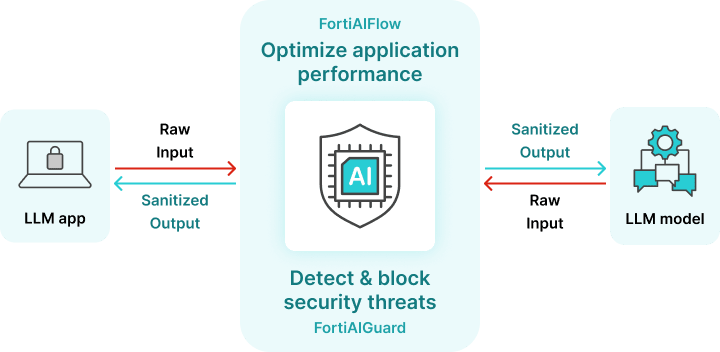
This shift is creating demand for a new category of security solutions. Platforms such as Fortinet’s FortiAI Gate have been designed specifically to provide visibility, policy enforcement and governance for AI applications. FortiAI Gate product overview
The emergence of solutions like FortiAI Gate reflects a broader trend. AI is no longer being treated as an experimental technology. Instead, organisations are beginning to recognise that AI requires the same level of visibility, governance and risk management as any other critical business system.
Emerging risk
Many organisations already have an AI adoption strategy. Far fewer have a strategy for monitoring, governing and securing AI usage across the business.
While this article focuses on how AI is changing the threat landscape, organisations should also consider the risks introduced by their own adoption of AI tools. Have a read of our latest article, where we explore the AI-related cybersecurity risks that business leaders should be aware of.
The future of cyber defence is operational maturity
When new technologies emerge, organisations often focus on the technology itself. Over time, however, the organisations that adapt most successfully tend to focus on operating models rather than individual tools.
Artificial intelligence is unlikely to be any different.
The organisations that gain the greatest benefit from AI will not necessarily be those with the largest security budgets or the most advanced technology stacks. More often, success will come from understanding how AI changes security operations and using it to improve visibility, decision-making and response times.
Human expertise will remain essential. Security professionals provide context, judgement and business understanding that technology cannot replace. However, asking skilled teams to spend their time reviewing large volumes of low-value alerts is neither efficient nor sustainable.
AI can help solve that problem. By reducing manual effort and improving operational efficiency, it allows security teams to focus on the incidents that genuinely require investigation and action.
Ultimately, the future of cyber defence is not about replacing people with technology. It is about combining visibility, automation and human expertise to build a more resilient security operating model.
Frequently asked questions
What are AI-powered cyber attacks?
AI-powered cyber attacks use artificial intelligence to accelerate activities such as phishing, reconnaissance, social engineering and vulnerability research. Rather than creating entirely new attack methods, AI helps attackers work faster, operate at greater scale and adapt their techniques more efficiently.
How are attackers using AI?
Threat actors use AI to generate convincing phishing content, analyse large volumes of information, automate research activities and scale campaigns more efficiently. As a result, attacks can be launched faster and adapted more easily.
Can AI improve cyber defence?
Yes. AI can help organisations analyse large volumes of security data, identify patterns, reduce alert fatigue and prioritise activity that requires investigation. Many modern security platforms now include AI-assisted detection and response capabilities.
What is the difference between SIEM and SOAR?
A SIEM collects, stores and analyses security data from across an environment. A SOAR platform focuses on automating response actions and executing predefined workflows when specific conditions are met.
What is a virtual SOC?
A virtual Security Operations Centre (vSOC) provides monitoring, investigation and escalation services without requiring an organisation to build a dedicated internal SOC. This approach helps improve security coverage while making more efficient use of internal resources.
What is prompt injection?
Prompt injection is a technique used to influence the behaviour of AI systems through carefully crafted inputs. As organisations adopt AI applications, prompt injection is becoming an increasingly important security consideration.
How can organisations prepare for AI-driven cyber threats?
A practical starting point is improving visibility. Organisations should ensure they have appropriate logging, monitoring and detection capabilities in place, understand the business impact of potential incidents and introduce automation where it provides clear operational value.
Want a practical perspective on cybersecurity?
Cybersecurity discussions often focus on technologies, products and emerging threats. In this video, Alan Kepper answers common cybersecurity questions raised by IT leaders and business decision-makers, drawing on more than 40 years of experience across communications, networking and digital infrastructure. Watch the video here
Speak with our team
Most organisations already have many of the technologies required to improve their cyber resilience. The challenge is understanding how those technologies fit together, where visibility gaps exist and which processes can be improved through automation.
If you’re evaluating your organisation’s security maturity, visibility capabilities or approach to security automation, the Laminar team can help identify practical next steps based on your environment, operational requirements and business objectives. Contact our team.
READ MORE NEWS
Related Articles

August 24, 2026
How to Adopt AI Safely in Your Business: Inside a CEO’s Real Decision-Making Process
READ ARTICLE

May 12, 2026
AI Cybersecurity Risks Every Business Leader Must Address in 2027
READ ARTICLE
This essay provides an interesting perspective on the power of the Oblong and how it might be used to manipulate humans. The author effectively uses examples from books like 1984 and Brave New World to illustrate the potential consequences of relying too heavily on the Oblong. The essay also discusses the divide between those who understand the potential danger of the Oblong and those who blindly trust it. Overall, the essay offers an interesting and thoughtful take on the power of the Oblong. – OpenAi engine…
I stole the concept of the Oblong from a book I read, Clara and the Sun, by Kazou Ishiguro.
The Oblong is the main or only source of information that humans use to make decisions about their life. What to eat, where to go, what to think, who to hang out with and what to do! Years ago humans used their 5 senses to make migratory, hunting, social and other critical decisions. Now the Oblong sits between the humans main senses, (visual, auditory, touch) and the real world to help the humans make sense of a huge amount of information and interact with each other and the universe.
What if the humans think they control their Oblong when in fact some one else controls the Oblong, what is presented and therefore controls the behaviour of the humans decision making. The humans often consider the aura of the oblong, its beauty and almost religious connection to a brand as they rush to trust something they don’t comprehend how it works.
What of the gap between knowledge of technology and the users of it.
George Orwell’s book, 1984 foreshadows (at the time) how restriction of information could or would be used to control the masses. He feared books or publications would be banned that presented an alternate view of the ruling political elite. That is, controlling the humans with deprivation or limiting of information.
Aldus Huxley – author of Brave New World, looks at the control of humans by providing an over supply of information. I have read that Huxley feared no one would read books, which is a very different take on things to Orwell. He was apparently concerned that if humans were presented with too much information that humans would be reduced to passivity and egotism.
Two ends of the spectrum maybe, but I suspect we might be hovering at one end at the moment.
Through the Oblong humans are presented with so much information, more than they scan process and work with. Emails, Social media, messaging, video, music, news and a range of APPs. Add to that a rush to trust the latest cool APP with expectation spooled up by clever marketing.
Very few have the ability to understand how the APP is working so most jump on and share videos or other details while the APP is doing something else. Collecting data. Even if you understand how it works and what is going you have to ostracise yourself from the rest of society to make sure you are not affected. Is it worth that? How lonely!
Maybe politicians can establish laws to bring some control but how were those politicians chosen. What is the of source of information the human used to make a decision on who to elect?
We released a messaging and social media application (LamChat) so that people can share stories and information securely without being tracked and the APP/System does not collect other information about the user. There are people who care about this confidentially and they use a system like LamChat, but they represent a very very slim minority.
Now we have had a series of publicised cyber security events that have affected a great deal of the population. There are several that have gained notoriety but these only represent a few in a long list of successful attack in the last few months. Why didn’t you hear about them? You probably did and its buried in the white noise of constant information overload.
Many of us in the cyber security industry figure out what has happened to a victim sometimes before the victims management or board do. It must be frustrating for them. They have built a business and profited from the efficiencies and speed of the digital revolution. They have typically not dealt with the human disciplines of operating infrastructure around security the value of information and the trust people place in them.
I think about the divide between the people whom know and those that blindly trust. In the past a government or ruler would make some laws to protect or manage the disruption to the kingdom to keep control and order. We have seen our government follow many others around the world to impose large fines on operators of infrastructure that people trust. The laws around privacy in Australia have been around for 4 years but the fines have just been increased dramatically and obligations for reporting have tightened in the last 2 months.
But what are we doing around the power of the Oblong and the impact it could have on our society if the power is misused?
Want to find out more? Contact us.
READ MORE NEWS
Related Articles
August 24, 2026
How to Adopt AI Safely in Your Business: Inside a CEO’s Real Decision-Making Process
READ ARTICLE

How to set up an intranet for a small business in Australia. Intranets have been around for decades! Companies use them to increase employee productivity and for internal communication, such as:
- Share news updates.
- Collaborate with colleagues when working on projects.
- Access tools to help them do their job efficiently.
- Connect with other employees on a social level.
So, if you’re wondering if your small business needs an intranet, the answer is yes! Read on to find out how to set up an intranet for a small business in Australia…
What is an intranet vs internet?
With the two terms sounding alike, it’s easy to confuse them to be the same thing. But there is a big difference.
- The internet: is a globally connected network. You can share information and communicate with people worldwide. Hence it is publicly available.
- The intranet: is a private communications network. It only allows people within an organisation to communicate, share and access information.
Other differences include
- The internet is the underlying technology used to connect the intranet.
- You can build, buy and sell the intranet.
There is also the extranet, which allows restricted access to people outside an organisation. Yet it is not publicly available. But, we won’t confuse you any further, and we’ll touch on this in another blog.
Why Your Small Business Needs an Intranet
Now you know the differences, below are some benefits you can expect from having an intranet for your small business.
The benefits of the Intranet
- Securely share information: You avoid miscommunication through office Chinese whispers, as critical corporate information comes from one source.
- Increased productivity: Managing workflow through emails can be tricky and inefficient. The intranet allows streamlining workflow by cutting out the clutter.
- Make remote working a breeze: With the increase in remote and hybrid working post the COVID-19 pandemic, the intranet allows staff to access the tools required to get the job done when they’re not in the office.
- Connect the workforce (internally and remotely): Teams from different departments and locations (internationally) benefit from collaborating on projects through one source. The intranet also allows team members to connect and engage with one another. Again, with remote working, the intranet helps staff to stay connected.
- Reinforce business values: Through the intranet, you can continuously share your corporate mission and values. You can reinforce these through open collaboration and activities.
- Easy access to information: This allows for improved efficiency with everything stored in one place. It also ensures vital project information isn’t lost when a staff member leaves.
How Intranets work and are secured
The intranet is hosted on a web server that uses TCP/IP, HTTP, and other internet protocols. You need a unique password connected to the company’s Local Area Network (LAN) to access the intranet. When working remotely, you need access through a secure connection such as a Virtual Private Network (VPN).
So, what makes this all so secure? Enter Firewalls. Firewalls guard between the external internet and the private intranet to provide security. They ensure malware, malicious attacks, and unauthorised requests do not enter the secure network of your intranet.
How to get an Intranet for your small business
You can build an intranet internally. But there are now a variety of intranet software applications available to buy. These are also known as Employee Experience Platforms. Each offers a wide array of applications based on your needs.
Contact Laminar for network solutions and cybersecurity
We help our clients make sense of the complications with building, operating, and owning modern IT networking Infrastructure. So, if you’re seeking intranet and cybersecurity solutions, contact us today!
READ MORE NEWS
Related Articles
August 24, 2026
How to Adopt AI Safely in Your Business: Inside a CEO’s Real Decision-Making Process
READ ARTICLE

Curious as to the 3 common cyber security questions we get asked?
Laminar are experts in implementing IT cyber security infrastructure. The three key areas we assess are:
- Detection and response
- Identification and Isolation
- Authentication and Authorisation
A secure infrastructure is crucial for protecting you, your business, your employees, and your data. Therefore, it is essential you understand even the basics of cyber security and why it matters.
To get you clued up, we cover the basics of cyber security and answer the 3 most common cyber security questions we get asked. So, to learn more, read on.
What is cyber security, and why does it matter?
Cyber security is the term given to the application of technologies and processes put in place to defend technological networks, devices, data, and programs from malicious cyber-attacks. This is done by anticipating, defending, and responding against cyber threats and breaches and is a crucial task carried out by specialists in the field.
As you may have gathered, cyber security is essential because it protects sensitive data from theft and damage, including:
- Personally identifiable information
- Healthcare information
- Government information
- Sensitive personal information
- Confidential industry information
With the increasing demand, usage, and growth in technology, hacking, ransomware, and cyber terrorism are on the rise, making cyber security an even more essential practice to have in place.
Common cyber security questions and answers
So, now you know the very core of cyber security, you may be wondering, what questions should I be asking about cyber security? Well, to get you started, here are three of the most common questions we get asked.
1. What is cryptography?
Simply put, cryptography is communicating in secure, hidden code language. It’s a little bit like in The Da Vinci Code, where the answer is hidden within a cryptex, however in the world of IT, it’s not quite the same. Instead, now it is used to protect digital data by encrypting data from plain text with other characters such as numbers for secure communication.
2. How does encryption work to protect my data?
So, we’ve briefly touched on encryption above, but you might still be questioning how it works to protect your data.
As we’ve covered, encryption uses a series of numbers for secure communication. Each number is unique and created using a set of rules. These rules, also known as algorithms, turn readable data into scrambled text, which requires a unique decryption key to unscramble the coded information into readable data.
There are two types of encryption systems:
- Symmetrical encryption – this uses a single password to both encrypt and decrypt data.
- Asymmetrical encryption – this requires two keys – a public key for encryption that may be shared amongst key personnel and a private key for decryption that is not shared.
It’s essential to encrypt your data. After all, you do not want hackers to know everything about your health and other private matters.
3. What are the main differences between IDS and IPS?
You’ve likely come across these terms at some point. But if you’re unsure of what they mean and, what the differences are, we’ve got the answers for you.
- Intrusion Detection System (IDS) – monitors and alerts you of an impending cyber threat.
- Intrusion Prevention System (IPS) – takes action to block any attempted threatful intrusion.
Together, they make a unified cyber threat management system crucial for network security.
Ask Laminar about Australian cyber security
Whether personal or professional, you must maintain good cyber security practices. While all individuals and businesses will have unique circumstances, you must assess your network security and include the following three questions on your cyber security checklist:
Do you have:
- Secure access for guests, BYOD, and corporate devices?
- Proactive control over access privileges?
- The full spectrum of visibility into your network?
At Laminar, we have been working with our clients on designing, building, and operating cyber security infrastructure. Traditionally we work with the information technology team. We still do, however, with the increasing profile of risks that many organisations face, we are finding that we are increasingly working with owners and boards or assisting the IT team.
We encourage you to ask questions and regularly analyse your cyber security needs. So, if you’ve got any questions you would like answered, call our team on 1300 486 373 or visit us here and start defending your castle today!
READ MORE NEWS
Related Articles
August 24, 2026
How to Adopt AI Safely in Your Business: Inside a CEO’s Real Decision-Making Process
READ ARTICLE

A new way to share
Laminar has released its new messaging service to the public. To make it easy to get started we have released our own APP for phones in the Apple and Google APP stores.
We have been using it at Laminar to communicate and share confidential information (internally and externally), such as passwords and other details.
With the level of cyber security activity at the moment, we thought that we would offer it to everyone for free. Especially our clients, others in our community and people in the IT&C industry.
It uses the latest ratchet-based encryption technology like many others around like Signal, WhatsApp, Messenger etc. BUT:
- The messaging servers are based in our datacenter in Brisbane. That means messages move from your handset to our message servers to the recipient’s handset. All metadata stays in the country on our servers and we don’t store messages (they stay on the handsets). Most other services operate in the same way but outside of our country.
- We won’t sell your metadata or correlate it with other information to sell things to you! Correlated metadata is very powerful for the people who have it. I am told they no longer need to decrypt the messages to know what is going on.
- The software on the handsets/computers and servers are open source or written by people in Brisbane. We have a high confidence that the software is clean. You can even use your own message apps if you want.
- LamChat has better security in group chat room situation. People can set up communities, rooms and individual chat groups. Communities and groups can be isolated from the public easily.

Why LamChat?
In the last few weeks there have been some significant cyber security events. I was thinking about how some of our clients have been impacted and what could we do to help generally.
One of our key agendas is that we like to know where our data is going and where it is stored. It is often not possible to know the absolute answer to this with cloud providers or many software vendors. However, it is not possible to participate in the modern world without taking some risks either.
For example, I share information on LinkedIn, Microsoft Office or Google Docs, knowing I have no idea where it is or who could be looking at it now or in the future. I know I can rely to a degree on major brands like Microsoft, Google or Apple to do a good job and do the best they can, because they have a reputation to protect.
I am especially concerned for information clients trust us to hold and manage.
We often need to communicate with clients and internally, sharing information such as passwords and network details. These details are sensitive so we only store and share this information with systems we build and operate in known locations.
To that end, we built our own messaging system and mobile application. We operate the message server in the physical datacentre infrastructure we built, own and operate. We built our own messaging app to ensure it connects with our server. We used open-source code where possible and the programmers are people who live in my city (I know where they live).
We are an Australian company bound by Australian laws. Most messaging providers are bound by US, EU or Chinese laws. If you are an Australian, then you have some say in what goes on with the laws that directly impact our company!


WhatsApp and Facebook recently announced a change to their terms of use which has many, including myself, concerned. They are concerned for their metadata. For many of us in our industry we have been warning people about the impact of the use of meta data by third parties, primarily to and market or advertise. We have also seen it used for political purposes.
To give you an idea on the power of metadata I have borrowed an infographic from an article in Forbes recently (see link below) but it shows what other messaging systems collect and correlate. Our system is like Signal, but the servers are in Australia.

To do our bit to help we are offering our messaging system to our wider community of customers, IT providers, competitors, governments, cyber security professionals, suppliers, partners, friends and family. It’s free. We won’t sell your metadata to be cross correlated with other marketing information either!!
I know people will still use the popular messaging systems, but if you need to collaborate confidentially please feel free to use our platform.
The Technology
Laminar has built a messaging infrastructure called LamChat within our secure infrastructure that operates from our data centre in Brisbane. We host everything within our physical infrastructure that we designed, procured, built and now operate. So, the data is always in that infrastructure.
LamChat is public friendly system based on the Matrix (www.matrix.org) ecosystem which is an open-source software system with a strong development following. We chose open-source code to minimise the chance of unclean code slipping into our solution from a software supply chain (Solarwinds/Jetbrain scenario).
The Matrix protocols provide state-of-the-art end-to-end-encryption via the Olm and Megolm cryptographic ratchets. This ensures that only the intended recipients can ever decrypt your messages, while warning if any unexpected devices are added to the conversation.
the encryption is based on the Double Ratchet Algorithm popularised by other messenger operators but extended to support encryption to rooms containing thousands of devices. Olm and Megolm are specified as an open standard.
LamChat works well with any open-source Matrix compliant application (client) and we recommend Element for server, desktop, and laptop users. Element is also available for mobile phones and tablets.
We can also connect IoT devices. When using open-source standard platforms there is some requirement to set them up initially, but it’s very simple. This system is ideal for more public messaging solutions because we are using an open source app which is available on more platforms and is feature rich app which includes voice and video calling
Lamchat is now in both the Android and Apple Store. Simply search ‘Lamchat’.
READ MORE NEWS
Related Articles
August 24, 2026
How to Adopt AI Safely in Your Business: Inside a CEO’s Real Decision-Making Process
READ ARTICLE

One of Laminar’s key engineering principles is being able to provide the real answer to things that are going on. That is – “This is engineering, no guesswork!”
The key requirement for us to live up to this in a timely manner is to have the right test equipment that can provide evidence! We need to measure and prove our propositions design and work, so over the years we have accumulated a large range of test gear and we are always trying the latest!
One of those is the new NetAlly. This device is a palm held 10G network analyser, wifi and cable tester. The system also connects to a cloud dashboard so we can record details of our tests for sharing or record test results for a long period of time.
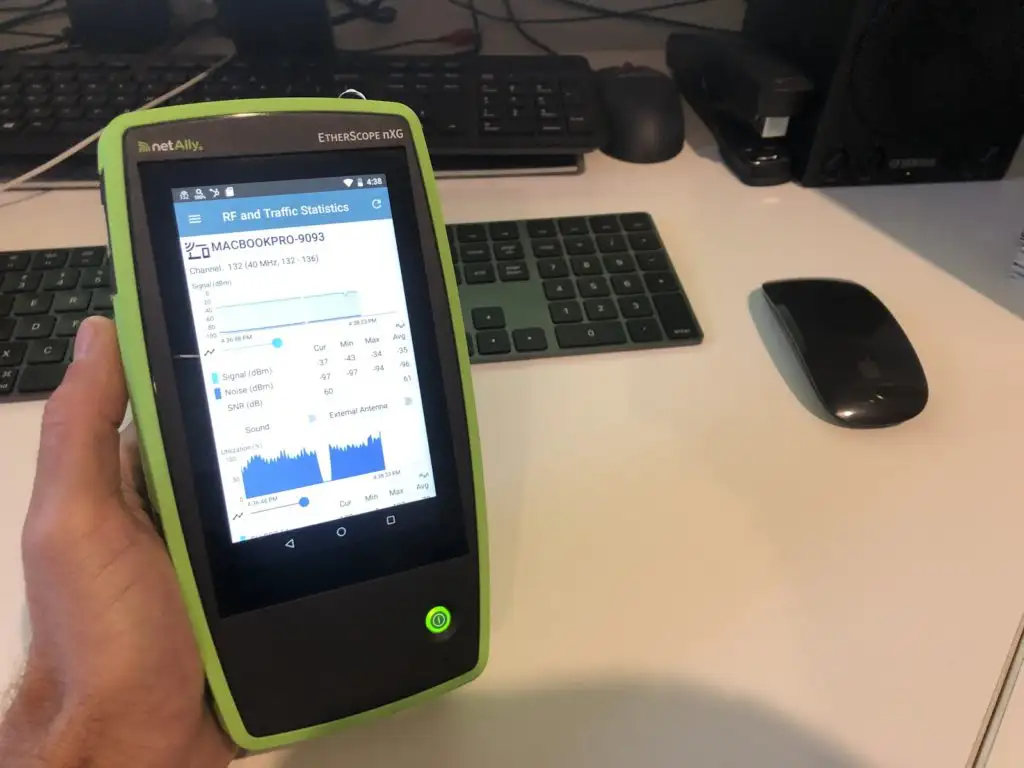
On many occasions we are called out to find or resolve a problem but it does not present itself when we turn up. We can leave this equipment onsite to measure details and record activity over a long time period. This allows us to observe the symptoms and correlate it with potential causes and provide proof of the event. We can also use this method to create benchmarks for future comparisons.
We can use the NetAlly for all sorts of WiFi tests but we can also conduct a wireless survey as the system integrates with our Airmagnet software. We can set up the survey in the hand held tool and simply conduct our walk around survey with the NetAlly.
When it comes to traditional networking, the NetAlly allows us to connect to a network and map out topologies, conduct load tests (wired and wireless), check switch and router parameters. With the cloud connection we can send out a junior engineer to a site with the tester and once connected specialist or more senior engineers can review the results in real time and direct suitable responses or remedial works.
With a click of a button we can conduct a network discovery which reports the results to the cloud account. We can then review it there and convert the results directly into a Visio document which is very handy when it comes to writing the report.
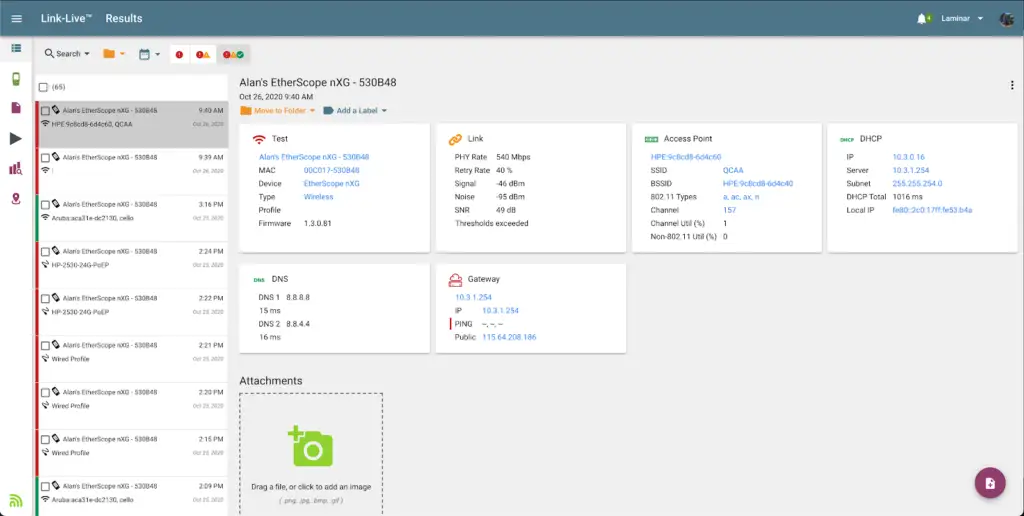
We can also use the tester with our Fluke cable test equipment for basic cable testing. Before deployment of new equipment on existing cable plant we often test critical paths beforehand to make sure we don’t spend time chasing other problems, especially during tight change control windows.
The NetAlly tool is Android based so you can add other applications from the playstore if you wish and ours came with a handy tool called a Netscout Test Accessory. It’s primarily used as an iPerf client/server for load testing but I have found it useful for reporting basic network information to the cloud account. Simply plug it into a switch port and it will connect, get an address and report some basic details for future review. Handy for wandering around client networks to record the basics.

READ MORE NEWS
Related Articles
August 24, 2026
How to Adopt AI Safely in Your Business: Inside a CEO’s Real Decision-Making Process
READ ARTICLE