


The Patch Window Is Dead. It’s Time to Automate.
Why traditional patch management can no longer keep pace with AI-accelerated threats, growing vulnerability volumes and modern cyber resilience requirements. Patch management automation is becoming essential as organisations face growing vulnerability volumes, faster exploitation timelines and increasing cyber resilience requirements.
For years, enterprise patch management followed a familiar rhythm. Vendors released updates, security teams assessed the risks, change advisory boards reviewed the impact and patches eventually made their way into production. The process was structured, predictable and designed to minimise operational disruption.
In many environments, it still works exactly the same way today.
The problem is that the threat landscape has changed dramatically while patch management processes have remained largely unchanged.
Attackers no longer operate on timelines measured in weeks. Vulnerability disclosures, exploit development and active attacks are happening faster than ever. As a result, patch cycles that once appeared responsible and controlled are increasingly becoming a source of risk.
Patch management was built for a different threat landscape
Traditional patch management evolved in an era where organisations could afford to be methodical. Vulnerabilities were disclosed, security teams assessed their impact and remediation activities were scheduled through planned maintenance windows.
That model assumed one important thing: defenders had time.
Today, that assumption is becoming increasingly difficult to justify. The volume of vulnerabilities continues to grow, threat actors have faster access to information and the time between disclosure and exploitation continues to shrink.
For many organisations, patch management is no longer a technical challenge. It has become a race against time.
The vulnerability explosion is becoming impossible to manage manually
The volume of vulnerabilities is increasing at a pace that is reshaping how patch management must be approached. CVE submissions have risen by 263% since 2020, creating a workload that makes manual prioritisation and remediation increasingly difficult for security teams.
Even NIST, which maintains and enriches vulnerability data through the National Vulnerability Database (NVD), has publicly acknowledged that it can no longer keep pace with the volume of vulnerabilities requiring analysis. As the backlog grows, organisations cannot rely on slow, manual interpretation processes to decide what needs attention first.
This creates a practical problem for defenders.
Security teams are expected to review, prioritise and remediate an ever-growing number of vulnerabilities while balancing operational requirements, resource constraints and business risk. In many organisations, vulnerability management programs are already struggling to keep up with the volume of issues requiring assessment.
The result is often vulnerability fatigue. Teams spend more time reviewing findings, managing exceptions and discussing priorities than actually reducing exposure.
AI is shrinking the window between disclosure and exploitation
Growing vulnerability volumes would be challenging enough on their own. However, artificial intelligence is introducing another factor that organisations need to consider.
Many defenders are already using AI to improve vulnerability analysis, threat intelligence processing and security operations. At the same time, attackers are using similar capabilities to accelerate exploit development and identify opportunities more efficiently. We explored this trend in more detail in our recent article on how AI is accelerating both cyber attacks and cyber defence.
Activities that previously required significant research and manual effort can now be performed much faster. As a result, the time between a vulnerability being disclosed and an exploit becoming available is shrinking.
This changes the economics of patch management.
A patch cycle measured in weeks may have been acceptable when attackers required significant time to weaponise vulnerabilities. Today, those same timelines can leave organisations exposed long after public disclosure.
Why the ASD Essential Eight changes the conversation
The Australian Signals Directorate (ASD) has already recognised this reality within the Essential Eight framework.
For organisations pursuing higher maturity levels, critical or actively exploited vulnerabilities affecting internet-facing systems may require remediation within 48 hours. Not two weeks. Not the next monthly maintenance cycle. Forty-eight hours.
That expectation reflects the current threat landscape.
It also highlights a challenge many organisations face. Meeting a 48-hour patching requirement across large and complex environments is extremely difficult when patching relies heavily on manual review, multiple approval layers and lengthy change management processes.
The issue is no longer whether patching is important. The issue is whether existing processes can operate at the speed required.
The real problem: humans have become the bottleneck
Security teams are not failing because they lack expertise.
In many cases, they are constrained by processes that were designed for a different era.
Manual reviews, approval chains, maintenance windows and change advisory board processes all have legitimate purposes. However, when every vulnerability requires the same level of scrutiny, organisations often struggle to respond quickly enough to the issues that matter most.
Not every patch carries the same level of risk. Not every system has the same level of criticality. Treating all patching activities as though they require identical governance creates unnecessary delays and consumes valuable resources.
The challenge is not removing human oversight. The challenge is applying human oversight where it delivers the greatest value. Many organisations are now supporting internal teams with virtual SOC capabilities to reduce operational overhead and improve response times.
What modern patch management should look like
Modern patch management should focus on risk-based automation rather than universal manual control.
| Traditional patch management | Risk-based automated patch management |
|---|---|
| Long approval cycles | Automated workflows |
| Uniform treatment of all patches | Prioritisation based on risk |
| Manual deployment activities | Automated deployment where appropriate |
| Limited response speed | Faster remediation of critical issues |
| Heavy operational overhead | Reduced administrative burden |
The objective is not to automate everything. The objective is to automate the activities that can be performed safely and consistently while retaining human involvement where judgement is required.
For example, organisations may choose to automatically deploy low-risk vendor-tested updates on non-critical systems while maintaining additional review processes for higher-risk changes affecting critical infrastructure.
Key takeaway: The question is no longer whether organisations should automate patch management. The question is which parts of the process can still afford to remain manual.
Automation doesn’t mean removing control
One of the most common concerns around automated patching is the perception that automation reduces governance.
In reality, effective automation often improves governance.
Well-designed patch automation includes testing procedures, approval rules, deployment policies, monitoring and rollback capabilities. Rather than removing control, it allows organisations to apply control more consistently and at greater scale.
The goal is not reckless automation. The goal is predictable, repeatable and risk-aware automation.
Organisations should be able to deploy routine updates quickly while maintaining stronger controls around changes that carry greater operational risk.
Want to explore which automations make sense for your business?
Leave your details here to book a conversation with our team and discuss practical opportunities to improve visibility, reduce operational overhead and strengthen cyber resilience.
A practical roadmap towards automated patch management
Most organisations do not need to transform their patch management program overnight.
A more practical approach is to introduce automation gradually.
Stage 1: Improve visibility
Develop a clear understanding of assets, vulnerabilities and patching status across the environment. Visibility is often the first challenge organisations need to solve before they can automate remediation activities effectively.
Learn how Lumenir, our SIEM-as-a-Service offering, helps organisations build the visibility required for modern cyber defence.
Stage 2: Prioritise by risk
Focus remediation efforts on vulnerabilities that create the greatest operational or security risk.
Stage 3: Automate low-risk updates
Identify routine patching activities that can be automated safely and consistently.
Stage 4: Introduce controlled automation
Expand automation through predefined workflows, testing procedures and rollback capabilities.
Stage 5: Continuously optimise
Review outcomes, refine policies and adjust automation strategies as business requirements evolve.
Frequently asked questions
What is automated patch management?
Automated patch management uses software and workflows to deploy updates with minimal manual intervention while maintaining governance and oversight controls.
Why is patch management becoming more difficult?
The number of vulnerabilities continues to increase, attackers can weaponise vulnerabilities more quickly and organisations are managing increasingly complex environments.
What does the ASD Essential Eight require for patching?
The Essential Eight includes specific remediation requirements for operating systems, applications and vulnerabilities, with stricter timelines at higher maturity levels.
Does automated patching increase risk?
Not necessarily. When implemented correctly, automation can improve consistency, reduce delays and help organisations respond more quickly to critical vulnerabilities.
Should every patch be automated?
No. Organisations should apply automation based on risk, business impact and operational requirements rather than adopting a one-size-fits-all approach.
Final thoughts
Patch management has traditionally been treated as a scheduling problem.
Increasingly, it is becoming a speed problem.
As vulnerability volumes continue to grow and attackers gain access to more powerful tools, organisations need to reconsider whether traditional patching processes remain fit for purpose. The goal is not to eliminate human oversight. The goal is to ensure that human expertise is focused where it matters most.
For many organisations, that journey will involve greater visibility, stronger prioritisation and a gradual move towards automation.
The patch window is not disappearing because organisations want it to.
It is disappearing because the threat landscape is moving faster than traditional processes can keep up.
READ MORE NEWS
Related Articles

August 24, 2026
How to Adopt AI Safely in Your Business: Inside a CEO’s Real Decision-Making Process
READ ARTICLE

May 12, 2026
AI Cybersecurity Risks Every Business Leader Must Address in 2027
READ ARTICLE
Why AI-powered cyber attacks are outpacing human defenders
Artificial intelligence is changing the speed and scale of modern cyber threats, making AI-powered cyber attacks a growing concern for organisations across Australia.
Over the last four decades, organisations have adapted to several major technology shifts. The rise of the internet, mobile devices, cloud computing, software-defined infrastructure and remote work have all changed how businesses operate and how technology environments are designed, managed and secured. Each of these developments delivered clear operational and commercial benefits, but they also introduced new dependencies, new risks and new opportunities for attackers.
Artificial intelligence is creating a similar transition. Most organisations are currently focused on the productivity benefits that AI can deliver, whether that involves analysing information more quickly, automating repetitive tasks or helping employees make better use of their time. At the same time, attackers are applying many of the same capabilities to activities such as reconnaissance, phishing, vulnerability research and social engineering.
Recent guidance published by the Australian Signals Directorate (ASD) highlights this dual reality. AI has the potential to support defenders by improving threat detection, accelerating investigation processes and reducing the manual effort associated with routine security tasks. However, the same technology can also help threat actors operate more efficiently by reducing the effort required to research targets, develop campaigns and adapt their techniques.

Image: ASD – Integrating AI for cyber security
Australian Signals Directorate guidance on AI in cyber defence
For technology leaders, the question is no longer whether AI will influence cybersecurity. Most organisations are already seeing evidence of that change. A more practical consideration is how security operations need to evolve when attackers can gather information faster, create more convincing content and execute activities at a scale that was previously difficult to achieve.
How AI-powered cyber attacks are changing the cyber threat landscape
One of the key observations in the ASD guidance is that artificial intelligence is not creating an entirely new category of cyber threats. Many of the techniques associated with AI-powered attacks, including phishing, reconnaissance and social engineering, have existed for years. What is changing is the speed, scale and efficiency with which those techniques can be executed.
For most organisations, this is a more immediate concern than highly sophisticated AI-driven attack scenarios. Existing attack methods are becoming easier to execute, more scalable and harder to manage through traditional security operations.
Phishing is a good example. AI can help attackers generate convincing content, adapt messaging to different audiences and produce campaigns at a scale that would previously have required significantly more effort. Similarly, AI can accelerate reconnaissance activities by analysing large volumes of publicly available information and identifying potential opportunities much faster than a person could.
Rather than introducing entirely new attack methods, AI is helping threat actors execute familiar techniques more efficiently. As a result, security teams have less time to identify suspicious activity and respond before an incident develops into a larger operational issue.
Key takeaway
AI is not creating entirely new cyber threats. It is accelerating existing attack techniques and allowing threat actors to operate faster, at greater scale and with less effort than before.
Many security programs were designed around a different operating rhythm. Historically, security teams had more time to investigate alerts, validate concerns and escalate issues before significant damage occurred. As attackers become more efficient and attack volumes increase, that assumption becomes increasingly difficult to rely upon. Consequently, organisations need to think not only about preventing attacks, but also about whether their security operations model is capable of responding at the speed required today.
Why traditional security operations struggle against AI-driven cyber attacks
Most organisations have invested heavily in cybersecurity over the past decade. Firewalls, endpoint protection platforms, identity management systems, email security tools and vulnerability management programs are now standard components of modern IT environments. While these technologies provide valuable visibility, they also generate a significant amount of security data.
The challenge for many organisations is no longer collecting information. Firewalls generate logs, endpoint platforms generate alerts, identity systems record authentication activity and cloud platforms produce audit events. Together, these data sources can create an overwhelming volume of information that becomes difficult to interpret without the right operational processes in place.
As attackers become faster and more efficient, security teams are expected to review increasing volumes of activity while operating with largely unchanged resources. Many organisations already have access to the information needed to identify threats, but determining which events require immediate attention and which represent normal activity can be time-consuming.
Adding more people does not always solve the problem. Experienced security professionals remain essential, but larger teams often inherit larger workloads when the underlying processes for identifying, prioritising and responding to threats remain unchanged.
For this reason, AI-assisted detection, event correlation and automation are becoming increasingly important within modern security operations. Their purpose is not to replace people. Instead, they help organisations process larger volumes of information more efficiently and ensure that human attention is focused on incidents that genuinely require investigation and judgement.
The organisations achieving the best outcomes are not choosing between people and technology. They are combining both to improve visibility, reduce operational noise and respond more effectively to potential threats.
As AI-powered cyber attacks continue to evolve, organisations need security operations that can detect, prioritise and respond to threats more efficiently.
Financial services offer a glimpse of what is coming
Although AI-driven security challenges affect organisations across every industry, financial services provide a useful indication of where cyber resilience expectations are heading. Banks, insurers and financial institutions operate in highly regulated environments, manage sensitive data and depend on complex digital systems to deliver core services.
For that reason, regulators tend to scrutinise not only whether financial organisations can prevent cyber incidents, but whether they can continue operating when incidents occur. This is an important shift. Cybersecurity is no longer being assessed only as a technical control issue. It is increasingly being treated as an operational resilience issue.
Recent commentary from ASIC reflects this broader direction. The financial services sector is being pushed to think more clearly about cyber risk, business continuity, governance and the consequences of failing to respond effectively when incidents occur.
ASIC commentary on cyber resilience and operational risk
Although these conversations are particularly visible within financial services, the underlying principles apply across many other sectors. Education providers, healthcare organisations, government agencies, manufacturers and professional services firms all depend on technology to deliver critical services. In each case, the organisation needs to understand which systems are essential, how long disruption can be tolerated and what actions should be taken if those systems become unavailable.
Question for leadership teams
If a critical business system became unavailable tomorrow, how long could your organisation continue operating effectively?
The question every organisation should be asking
Many cybersecurity conversations still begin with tools. Organisations ask whether they need a new firewall, a new endpoint platform, a SIEM, a SOC service or a SOAR capability. These are valid questions, but they are not always the best starting point.
A more useful starting point is to work backwards from the impact of an incident. If an attacker gained access to a critical system, what would happen next? Rather than focusing solely on the technical compromise, organisations should consider the operational consequences. Which systems could be affected? Would any services need to be isolated? Who would need to be informed? And which actions would need to happen immediately to reduce business impact?
This approach changes the conversation. Instead of treating cybersecurity as a collection of products, it treats it as an operating model. The objective becomes understanding how the organisation detects issues, decides what matters and responds in a way that limits business impact.
That operating model depends on visibility. Without visibility, an organisation cannot confidently understand what is happening. Without that understanding, it is difficult to prioritise risks or automate response actions safely.
This is where many organisations need to focus before moving too quickly into advanced automation. Automation is only useful when the organisation has enough context to know what should happen when specific conditions occur.
A practical roadmap for defending against AI-assisted attacks
For most organisations, the move towards AI-assisted cyber defence should happen in phases. Attempting to automate response actions before establishing visibility and context can create operational risk. A more practical approach is to build maturity progressively.
| Stage | Objective |
|---|---|
| Visibility | Understand what is happening across the environment |
| Understanding | Assess business impact and operational risk |
| AI-assisted operations | Prioritise, correlate and investigate activity faster |
| Automated response | Execute approved actions consistently and quickly |
Stage 1: Visibility
Visibility is the foundation of modern cyber defence. Organisations need to understand what is happening across users, devices, applications, cloud services, network infrastructure and security controls.
This is where a SIEM becomes important. A well-implemented SIEM collects and centralises security telemetry, giving teams a clearer view of activity across the environment. It also creates the data foundation required for later stages of maturity, including AI-assisted analysis and automated response.
For organisations looking to centralise security visibility and improve their ability to detect meaningful activity, Lumenir provides a practical foundation for modern security operations.
Visibility remains one of the most important requirements for detecting AI-powered cyber attacks before they escalate.
Stage 2: Understanding
Visibility alone is not enough. Once information is being collected, the organisation needs to understand what that information means in a business context.
This means identifying critical systems, understanding dependencies, defining acceptable downtime and mapping the potential impact of different incident scenarios. A security alert affecting a low-risk system does not carry the same operational consequence as suspicious activity involving identity systems, finance platforms or core infrastructure.
This stage is important because it informs response decisions. If an organisation understands the potential blast radius of an incident, it can make better decisions about escalation, containment and recovery.
Stage 3: AI-assisted operations
Once visibility and context are established, AI-assisted operations can help security teams work more efficiently. This may include event correlation, anomaly detection, alert prioritisation and noise reduction.
Many organisations do not have the internal resources to monitor security activity continuously or investigate every alert in depth. A virtual Security Operations Centre, or vSOC, can help by providing monitoring, triage and escalation support without requiring the organisation to build a full internal SOC capability.
Explore Virtual SOC and incident response service.
The purpose of AI-assisted operations is not to remove humans from the process. It is to ensure human attention is directed towards activity that genuinely requires investigation and judgement.
This capability becomes increasingly valuable as organisations face a growing volume of AI-powered cyber attacks.
Stage 4: Automated response
Automated response is the stage many organisations associate with SOAR. A SOAR platform allows approved response actions to be executed automatically when specific conditions are met.
For example, if a user account shows behaviour consistent with compromise, an approved playbook may trigger account suspension or forced password reset. If suspicious activity is detected on a critical system, segmentation or isolation steps may be initiated. If indicators of ransomware behaviour appear, predefined containment actions can begin before the incident spreads further.
The important point is that automation should not be uncontrolled. It should be based on approved playbooks, agreed thresholds and clear operational rules. The value of SOAR is that it allows known response actions to happen quickly and consistently when time matters.
Cyber defence maturity model
Visibility → Understanding → AI-assisted operations → Automated response
You cannot automate what you cannot see, and you cannot confidently respond to risks you do not understand.
Securing AI is becoming part of the challenge
While much of the cybersecurity discussion focuses on how attackers are using AI, organisations are increasingly facing a second challenge: securing their own use of AI.
Over the last two years, tools such as ChatGPT, Microsoft Copilot and Gemini have moved rapidly into everyday business operations. In many organisations, employees are already using AI to analyse information, generate content and improve productivity. However, governance frameworks and security controls have not always evolved at the same pace.
As adoption increases, organisations need to understand what information is being shared with AI platforms, how those platforms are being used and whether appropriate controls are in place. Questions around data leakage, prompt injection, access control and AI governance are becoming increasingly relevant.
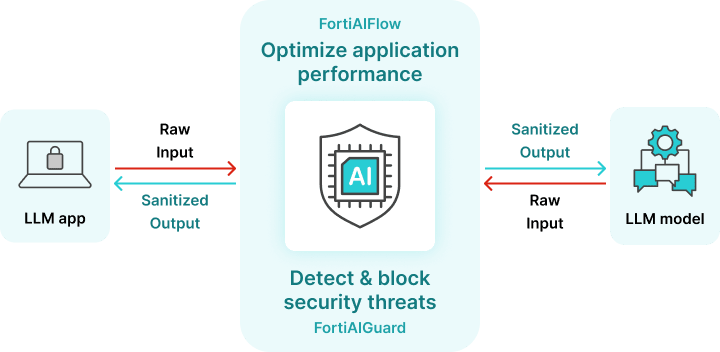
This shift is creating demand for a new category of security solutions. Platforms such as Fortinet’s FortiAI Gate have been designed specifically to provide visibility, policy enforcement and governance for AI applications. FortiAI Gate product overview
The emergence of solutions like FortiAI Gate reflects a broader trend. AI is no longer being treated as an experimental technology. Instead, organisations are beginning to recognise that AI requires the same level of visibility, governance and risk management as any other critical business system.
Emerging risk
Many organisations already have an AI adoption strategy. Far fewer have a strategy for monitoring, governing and securing AI usage across the business.
While this article focuses on how AI is changing the threat landscape, organisations should also consider the risks introduced by their own adoption of AI tools. Have a read of our latest article, where we explore the AI-related cybersecurity risks that business leaders should be aware of.
The future of cyber defence is operational maturity
When new technologies emerge, organisations often focus on the technology itself. Over time, however, the organisations that adapt most successfully tend to focus on operating models rather than individual tools.
Artificial intelligence is unlikely to be any different.
The organisations that gain the greatest benefit from AI will not necessarily be those with the largest security budgets or the most advanced technology stacks. More often, success will come from understanding how AI changes security operations and using it to improve visibility, decision-making and response times.
Human expertise will remain essential. Security professionals provide context, judgement and business understanding that technology cannot replace. However, asking skilled teams to spend their time reviewing large volumes of low-value alerts is neither efficient nor sustainable.
AI can help solve that problem. By reducing manual effort and improving operational efficiency, it allows security teams to focus on the incidents that genuinely require investigation and action.
Ultimately, the future of cyber defence is not about replacing people with technology. It is about combining visibility, automation and human expertise to build a more resilient security operating model.
Frequently asked questions
What are AI-powered cyber attacks?
AI-powered cyber attacks use artificial intelligence to accelerate activities such as phishing, reconnaissance, social engineering and vulnerability research. Rather than creating entirely new attack methods, AI helps attackers work faster, operate at greater scale and adapt their techniques more efficiently.
How are attackers using AI?
Threat actors use AI to generate convincing phishing content, analyse large volumes of information, automate research activities and scale campaigns more efficiently. As a result, attacks can be launched faster and adapted more easily.
Can AI improve cyber defence?
Yes. AI can help organisations analyse large volumes of security data, identify patterns, reduce alert fatigue and prioritise activity that requires investigation. Many modern security platforms now include AI-assisted detection and response capabilities.
What is the difference between SIEM and SOAR?
A SIEM collects, stores and analyses security data from across an environment. A SOAR platform focuses on automating response actions and executing predefined workflows when specific conditions are met.
What is a virtual SOC?
A virtual Security Operations Centre (vSOC) provides monitoring, investigation and escalation services without requiring an organisation to build a dedicated internal SOC. This approach helps improve security coverage while making more efficient use of internal resources.
What is prompt injection?
Prompt injection is a technique used to influence the behaviour of AI systems through carefully crafted inputs. As organisations adopt AI applications, prompt injection is becoming an increasingly important security consideration.
How can organisations prepare for AI-driven cyber threats?
A practical starting point is improving visibility. Organisations should ensure they have appropriate logging, monitoring and detection capabilities in place, understand the business impact of potential incidents and introduce automation where it provides clear operational value.
Want a practical perspective on cybersecurity?
Cybersecurity discussions often focus on technologies, products and emerging threats. In this video, Alan Kepper answers common cybersecurity questions raised by IT leaders and business decision-makers, drawing on more than 40 years of experience across communications, networking and digital infrastructure. Watch the video here
Speak with our team
Most organisations already have many of the technologies required to improve their cyber resilience. The challenge is understanding how those technologies fit together, where visibility gaps exist and which processes can be improved through automation.
If you’re evaluating your organisation’s security maturity, visibility capabilities or approach to security automation, the Laminar team can help identify practical next steps based on your environment, operational requirements and business objectives. Contact our team.
READ MORE NEWS
Related Articles
August 24, 2026
How to Adopt AI Safely in Your Business: Inside a CEO’s Real Decision-Making Process
READ ARTICLE
May 12, 2026
AI Cybersecurity Risks Every Business Leader Must Address in 2027
READ ARTICLE
This essay provides an interesting perspective on the power of the Oblong and how it might be used to manipulate humans. The author effectively uses examples from books like 1984 and Brave New World to illustrate the potential consequences of relying too heavily on the Oblong. The essay also discusses the divide between those who understand the potential danger of the Oblong and those who blindly trust it. Overall, the essay offers an interesting and thoughtful take on the power of the Oblong. – OpenAi engine…
I stole the concept of the Oblong from a book I read, Clara and the Sun, by Kazou Ishiguro.
The Oblong is the main or only source of information that humans use to make decisions about their life. What to eat, where to go, what to think, who to hang out with and what to do! Years ago humans used their 5 senses to make migratory, hunting, social and other critical decisions. Now the Oblong sits between the humans main senses, (visual, auditory, touch) and the real world to help the humans make sense of a huge amount of information and interact with each other and the universe.
What if the humans think they control their Oblong when in fact some one else controls the Oblong, what is presented and therefore controls the behaviour of the humans decision making. The humans often consider the aura of the oblong, its beauty and almost religious connection to a brand as they rush to trust something they don’t comprehend how it works.
What of the gap between knowledge of technology and the users of it.
George Orwell’s book, 1984 foreshadows (at the time) how restriction of information could or would be used to control the masses. He feared books or publications would be banned that presented an alternate view of the ruling political elite. That is, controlling the humans with deprivation or limiting of information.
Aldus Huxley – author of Brave New World, looks at the control of humans by providing an over supply of information. I have read that Huxley feared no one would read books, which is a very different take on things to Orwell. He was apparently concerned that if humans were presented with too much information that humans would be reduced to passivity and egotism.
Two ends of the spectrum maybe, but I suspect we might be hovering at one end at the moment.
Through the Oblong humans are presented with so much information, more than they scan process and work with. Emails, Social media, messaging, video, music, news and a range of APPs. Add to that a rush to trust the latest cool APP with expectation spooled up by clever marketing.
Very few have the ability to understand how the APP is working so most jump on and share videos or other details while the APP is doing something else. Collecting data. Even if you understand how it works and what is going you have to ostracise yourself from the rest of society to make sure you are not affected. Is it worth that? How lonely!
Maybe politicians can establish laws to bring some control but how were those politicians chosen. What is the of source of information the human used to make a decision on who to elect?
We released a messaging and social media application (LamChat) so that people can share stories and information securely without being tracked and the APP/System does not collect other information about the user. There are people who care about this confidentially and they use a system like LamChat, but they represent a very very slim minority.
Now we have had a series of publicised cyber security events that have affected a great deal of the population. There are several that have gained notoriety but these only represent a few in a long list of successful attack in the last few months. Why didn’t you hear about them? You probably did and its buried in the white noise of constant information overload.
Many of us in the cyber security industry figure out what has happened to a victim sometimes before the victims management or board do. It must be frustrating for them. They have built a business and profited from the efficiencies and speed of the digital revolution. They have typically not dealt with the human disciplines of operating infrastructure around security the value of information and the trust people place in them.
I think about the divide between the people whom know and those that blindly trust. In the past a government or ruler would make some laws to protect or manage the disruption to the kingdom to keep control and order. We have seen our government follow many others around the world to impose large fines on operators of infrastructure that people trust. The laws around privacy in Australia have been around for 4 years but the fines have just been increased dramatically and obligations for reporting have tightened in the last 2 months.
But what are we doing around the power of the Oblong and the impact it could have on our society if the power is misused?
Want to find out more? Contact us.
READ MORE NEWS
Related Articles
August 24, 2026
How to Adopt AI Safely in Your Business: Inside a CEO’s Real Decision-Making Process
READ ARTICLE

As we stumbled our way through the multiple lockdown periods and working from home during the COVID-19 pandemic, there was one thing that allowed us to stay connected with our teams – video conferencing. We worked through several technical glitches and came to terms with a new way of working life. Now it’s safe to say that technology and businesses have adapted to this new way of working. To ensure you are confidently ready and have the right setup for the future of video conferencing, we’ve put together a list of the essential equipment you need. So sit back and read on to find out about: All the Equipment you Need for Effective Video Conferencing in Australia.
Why video conferencing is necessary in 2022
If there is one thing we learned during the COVID-19 pandemic – we can work from anywhere. As many of us shifted our mindset and outlook on life and work, so have businesses. Workplaces are shifting towards flexible, hybrid, and remote working conditions. Hence, as you prepare for meeting with your colleagues or stakeholders when working out of the office, you need the right video conferencing equipment to help you put your best foot forward.
Equipment you need for video conferencing
So, now we know why video conferencing is an essential part of our work lives, here are a few proven tips to ensure your video meetings run without a glitch.
- Stable internet connection
First, ensuring you have a stable and fast internet connection is essential to avoid visual disruptions and a lag in the audio. If you are working remotely, consider connecting via ethernet to avoid speed and dropout issues that can be a problem when using Wi-Fi.Let’s not forget security. If you are on Wi-Fi, ensure the connection is encrypted and protected. - Camera and webcam
There’s no video conferencing without a camera. Whether you’re using the camera on your phone or the webcam on your laptop or PC – quality matters. Most webcams these days offer high definition for a sharper, more professional look when on a video call.Not sure what webcam to buy? Don’t worry – we have you covered. Check out TechRadar’s guide on the best webcams in 2022 for working and streaming. - Tripod for your phone camera
If you find yourself using your phone for online meetings more than your laptop or PC, you’ll want to consider investing in one of the best tripods for iPhones and smartphones. A reliable and sturdy tripod will allow you to set the phone camera at a suitable distance and angle. You can be hands-free to take notes and don’t have to worry about any wobbly moments. - External microphone
You may wonder why you need an external microphone when you could use the one on your computer. Well, while you might see microphones as an extra investment, this little extra will provide your video calls with optimal sound quality. Best of all, they reduce echoes and offer noise-cancelling benefits. - Lighting
Video conferencing lighting is an ongoing battle, especially when you are in a room that is not lit properly or lacks ample natural light. That’s why artificial ring lightingis the next best thing. That’s right – they’re not just for mobile vlogging. You can easily buy one at Office Works or on Amazon for as little as thirty dollars.
Basic Troubleshooting Tips
While you may be well-equipped, there are a few basic things you need to remember to do, such as
- Check the gain on your microphone.
- Ensure your video is well-framed before you begin.
- Unmute yourself on the software.
- Allow permissions on your device.
Excel at video conferencing in Australia with Laminar Solutions
At Laminar, we offer custom solutions to ensure your business infrastructure is operating at optimum capacity and that your most important assets are protected. So, whether you’re looking for wireless solutions to provide robust internet connections or want to ensure you have the best cyber security for video conferencing, we can provide you with a tailored solution to suit your needs.
Talk to our team today. Call 1300 486 373.
READ MORE NEWS
Related Articles
August 24, 2026
How to Adopt AI Safely in Your Business: Inside a CEO’s Real Decision-Making Process
READ ARTICLE

Imagine if your hard drive crashed and you lost all your work? Or all your work is accidentally deleted! As nail-bitingly scary as it sounds, the truth is, it happens very often. That’s why it’s essential to back up all your work.
Whilst external hard drives are a great way to save copies of your work – they can sometimes come with the challenge of being misplaced and security risks. Thus, it doesn’t hurt to back up the backup with reliable online cloud storage. So, without further ado, let’s take a deeper look at the best cloud backup systems and some of the most recommended cloud storage options.
What does cloud backup do?
The cloud, also known as online backup, is a method of safely saving and storing a copy of your files on a hosted server delivered over the internet. These servers are in data centers across the world.
The cloud allows you to access your files and applications anywhere and on any device. This is possible because of a technology called virtualisation. Virtualisation uses software to create a virtual machine enabling organisations to run multiple systems and applications on one server. There are several benefits of virtualisation, including
- Cutting down on IT costs
- Increase efficiency and productivity
- Economies of scale
Five advantages of cloud backup
On the other hand, the advantages of cloud storage for businesses include:
- Data protection
- Cost-effective and affordable
- Easy access anytime, anywhere
- Simple to use and boost efficiency and productivity
- Automated solutions allowing to schedule backups
If you’re wondering why it’s called the cloud – well, it all began with industry slang and stuck around.
What to look for in cloud backup
We often get asked what should I look for when choosing a cloud provider. To answer this question, we suggest you look for the following.
- Cloud security features offered both paid and free.
- Ensure the cloud backup solution helps you meet compliance standards within your industry.
- Consider both the sticker price and associated costs.
- Consider how the system will fit into the business architecture. E.g., if your business uses Microsoft or Google services, look for a vendor that will allow for ease of integration.
- Think about day-to-day manageability. You want something that requires less time and effort to get your head around and work with.
- Factor in after-care support. Think about the level of support you wish to have. Will an online chat service be enough, or do you want more?
There are a fair few things to think about before you go ahead and select the most suitable cloud backup storage for you. Just because Google says it’s top-rated doesn’t mean it will be the one for you.
Cloud backup systems we recommend
To help your decision-making easier – we’ve listed three of the top cloud backup solutions we recommend.
These are just the top three to get you started. There are also mobile solutions available for safeguarding your contacts, messages, photos, and documents on your phone, such as G cloud backup.
Get expert advice on cloud backup systems with Laminar
You don’t have to make these decisions on your own. Laminar works closely with the client to provide network solutions whether it be onsite, campus, Datacenter or cloud-based, to best suit the needs of the client and its existing infrastructure and environment.
Laminar’s qualified staff can work with a variety of technologies and maintain vendor partnerships for the best pricing and new technology opportunities.
We work with small businesses through to large enterprises. This broad range of experience enables Laminar to provide robust solutions, whether working with a client’s existing infrastructure or engineering a new solution.
Contact our team today and get the solution to your IT needs.
READ MORE NEWS
Related Articles
August 24, 2026
How to Adopt AI Safely in Your Business: Inside a CEO’s Real Decision-Making Process
READ ARTICLE

Are you frustrated with slow internet speed disrupting your ability to connect with customers and get daily tasks done? You’re not alone. For a long time, Australian businesses have struggled with slow internet speed. But the good news is, there is a solution to the problem -NBN, also known as the National Broadband Network. Read on to find out about the NBN benefits you should know about for your business…
What is the National Broadband Network (NBN)?
So, now that we know the solution, you might ask – what is NBN and how does it work? In a nutshell, the NBN network is an Australian Government initiative designed to deliver high-speed, reliable internet by replacing copper wires and cables (used by ADSL and cable networks) with fibre optic lines.
Although an Australian Government initiative, the company responsible for rolling out NBN is a company named NBN Co. To achieve the goal of all Australians having access to fast broadband at an affordable price, NBN “provides services on its local access network on equivalent terms to retail phone and internet providers, to provision for end-user needs.”
Benefits of NBN over ADSL for businesses
So, now that we’ve covered some of the basics of the NBN rollout, it’s time to get on to the good stuff!
We’ve discovered that the NBN network brings the benefits of faster, more reliable internet. But what other benefits does NBN offer over ADSL, especially for businesses? Let’s take a look.
Five benefits of NBN over ADSL for businesses
- Improved online connectivity: for better customer service and business growth.
- Cloud-based apps: enable you to stay connected with your clients.
- Flexible working environment: allowing teams to connect and work seamlessly in the new age of remote and hybrid working.
- Staying local – while going global: as it breaks the barrier to global connectivity allowing your business to go international.
- Increased productivity: as you no longer have to wait for things to download and connect.
There are plenty more benefits we can list, but for now, we’re going to keep it short and sweet. But before we move on, one of the main things that sets NBN apart from ADSL is that NBN offers dedicated solutions tailored to the evolving needs of businesses with their business NBN products and services.
How to get connected to NBN
Getting connected to NBN is simple. Available from a range of providers, such as Optus and Telstra, you can choose a plan that best suits your business requirements. You can choose from a variety of flexible options that offer
- Symmetrical upload and download speeds
- Priority data
- Business-grade 24-hour service seven days a week
To help you get connected, NBN Co provides a step-by-step guide on how to make the switch.
Before going ahead, we suggest you speed-test your NBN to determine the speed you need. Other things to consider are
- What will you use the internet for? (email/storage/video calls).
- How many devices will you be connecting, and will they all be connected at the same time? (If you’re a big organisation with a large network or a small business with only one computer and mobile connection).
- What speeds are available on your network type? (For instance, FTTP and HFC enable access to all speeds. Whilst with FTTN, FTTB, and FTTC, you might be limited. If you don’t know, you can check via NBN’s check your address tool).
- What is your budget?
Contact Laminar for custom network solutions
As every business grows, so does its core infrastructure. Laminar can offer a tailored solution to your organisation for a seamless changeover and minimal downtime. Laminar provides, installs, and commissions. We also support switching, routing, and networking technologies to meet clients’ LAN and WAN networking requirements.
So, if you’re upgrading your broadband network, contact us today!
READ MORE NEWS
Related Articles
August 24, 2026
How to Adopt AI Safely in Your Business: Inside a CEO’s Real Decision-Making Process
READ ARTICLE